Downshift Pressure Board Review (2026): Can a $89 Board Replace a $10,000 Force Plate?
Birdie Score
Price
$89
One-Putt Summary
The Downshift Pressure Board makes the invisible visible — if you can't feel your pressure shift, this board will show you exactly where you're going wrong, fast.
Fairways (Pros)
- ✓ Immediate visual feedback — you see the tilt, you feel the shift
- ✓ Works without hitting balls — garage, living room, backyard
- ✓ Coaches rate it as an affordable substitute for $10K+ force plate systems
- ✓ Unexpectedly effective for short game (chipping/pitching) — not just full swing
Hazards (Cons)
- ✗ Bottom dowel slips on smooth indoor turf and wet mats — a fixable but annoying design gap
- ✗ Easy to misuse: swaying your mass vs. genuinely shifting pressure look the same without guidance
- ✗ A near-identical DIY version costs $15–30 at a hardware store — a real question for budget buyers
Best For
Mid-to-high handicap golfers (10–25 HCP) who struggle with hanging back, early extension, or hitting fat iron shots — especially those who practice with a coach or quality video instruction on a stable hitting surface
⛳ One-Putt Summary
The Downshift Pressure Board makes the invisible visible — if you can’t feel your pressure shift, this board will show you exactly where you’re going wrong, fast.
Overall Score
Conditional Buy — A genuinely effective pressure shift trainer for mid-to-high handicappers. Scores highest on effectiveness and customer support. Held back by surface slipping issues, limited independent reviews, and the hard-to-ignore DIY alternative.The Hook: What You’re Actually Buying
Here’s a question your golf instructor probably hasn’t asked you: do you actually know what your feet are doing during your golf swing?
Not your arms. Not your shoulder turn. Your feet — specifically, which one is bearing your weight, and more importantly, when.
If you’ve ever been told you’re “hanging back,” “staying on your rear foot,” or “not transferring your weight,” you’re not alone. It’s the single most common fault in amateur golf. And it’s maddening because it’s nearly invisible to the player — you think you’re shifting your weight, but you’re not. Not early enough, not deeply enough, not in the right direction.
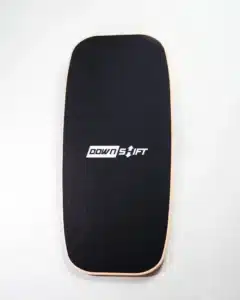
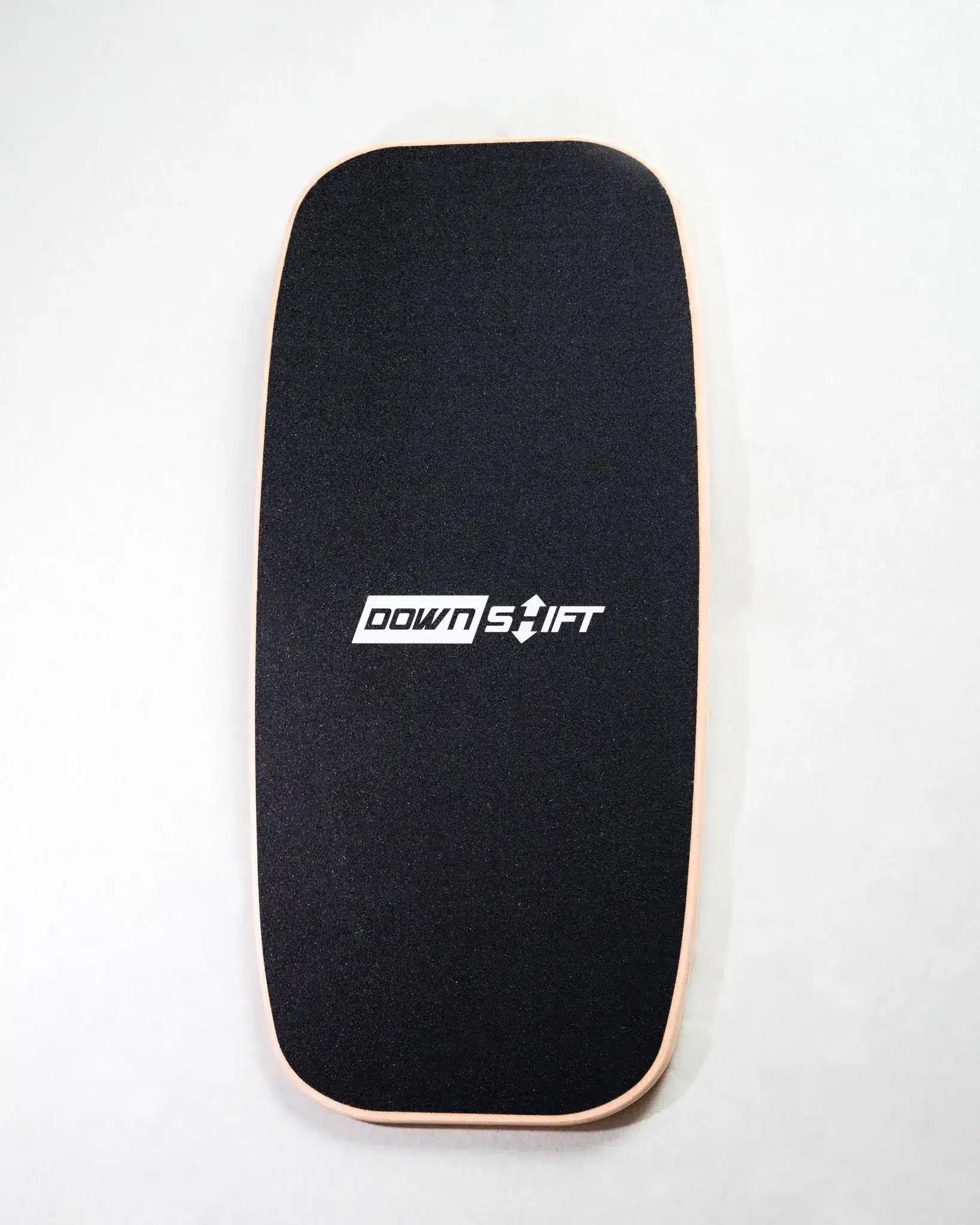
The Downshift Pressure Board is a deceptively simple piece of kit: a wooden board that balances on a central dowel, roughly the size of a welcome mat. You stand on it and swing. When your pressure shifts to your lead side, the board tips. When it doesn’t — it doesn’t. No app. No launch monitor required. No electricity. Just instant, physical, honest feedback on what your center of pressure is doing.
At $89, it sits in an interesting no-man’s-land: too expensive to be a throwaway, cheap enough to be within reach for most serious amateur golfers. The question this review will answer is whether it earns its place in your practice bag — or whether you’d be better off heading to the hardware store.
What Is the Downshift Pressure Board?
The Downshift Pressure Board is a wooden rocker-style training aid designed around one specific concept: teaching golfers to shift their center of pressure (CoP) to their lead side before they begin the downswing.
That sounds technical. Here’s the analogy that makes it click: imagine a seesaw. Right now, most amateur golfers ride the seesaw the wrong way — their weight stays on the right side (for right-handers) while they try to hit the ball. Pros do the opposite: they start shifting the seesaw toward the target even before the club reaches the top of the backswing. That split-second lead is what creates ground reaction force, kinetic chain speed, and — ultimately — more yards with less effort.
The Downshift Board turns that seesaw metaphor into a physical reality you can feel under your feet. The board sits on a central half-round dowel. When your pressure is neutral, it balances. When you load your lead side correctly, it tips toward the target. When you hang back — it stays flat, exposing the fault you probably didn’t know you had.
Product At-a-Glance
The product comes from a small, founder-led operation. Jeff, the founder, is frequently cited by reviewers for exceptional post-sale support — sending personalized drill videos, following up after purchase, and being genuinely responsive. It’s not a faceless brand.
The board has been used by coaches and players on the LPGA, Korn Ferry, PGA Tour, and KLPGA. That’s not marketing fluff — it’s consistent with what the coaching community says about it. They love it because it democratizes feedback that used to cost tens of thousands of dollars.
Build Quality & Durability
Let’s get this out of the way: yes, it’s a piece of wood with grip tape on it. If you’re expecting to open the box and find a tech gadget, recalibrate expectations.
But within those humble materials? The build is genuinely solid. Users across multiple review platforms describe it as “extremely sturdy,” “very professional,” and a product that “holds up with lots of use” — the last point coming from a PGA teaching professional who runs it through high-volume daily lessons.
The top surface is covered in skateboard-grade grip tape, which provides excellent traction for golf shoes. The corners are rounded and the wood finish is clean — this reads as a thoughtfully made product, not a garage project.
⚠️ Design Gap Worth Knowing
The top has grip tape. The bottom dowel — the contact point that actually touches your mat or ground — has no grip treatment whatsoever. That smooth wood-on-mat contact is the root cause of the board’s most common complaint: it slides. It’s fixable (users add non-slip tape or rubber grips), but it’s surprising that a product this considered overlooked it.
One minor gripe that comes up consistently: the grip tape on top is abrasive enough to cause skin irritation when you carry the board, particularly on your thumb. No handle, no carry case. For a product you’ll be transporting to the range regularly, that’s a quality-of-life miss.
The dimensions (approximately 31″ × 15″) mean it won’t fit in a standard golf bag. It’s a trunk item. Not a dealbreaker, but worth knowing before you buy.
Overall: for its price point, the build quality is above expectation. PGA professionals are using these daily, which tells you something about durability.
Solid construction above its price point — dowel grip is the one miss
Effectiveness: Does It Actually Fix Your Swing?
This is where the Downshift Board earns its keep — and it’s the most important question to answer honestly.
The Core Win: Instant Feedback on Timing
The single strongest consensus across coaches, recreational golfers, and verified buyers is this: the board makes your pressure shift timing immediately, undeniably visible. You’ve probably been told to “shift your weight” a hundred times. The board shows you whether you actually are — in real time, with zero latency.
An 18-handicapper documented 30 yards of additional distance and improved iron low-point control after a single session. A YouTube coach demonstrated a 5 mph clubhead speed increase (86 to 91 mph) in a few swings using the board alongside a launch monitor. These are real numbers from real sessions, not manufacturer projections.
The most vivid picture of its effectiveness: a golf instructor posted to Instagram that “almost everyone who hops on a Downshift Board for the first time and tries to make a full swing nearly falls.” That’s not a design flaw — it’s the product working. It’s exposing how dramatically late most amateurs’ pressure shift actually is.

The Thing That Makes Pro Swings Look Effortless
Elite ball-strikers shift their center of pressure toward the target before their arms complete the backswing. This isn’t a style choice — it’s what creates the stretch-shortening cycle in the hips that generates power from the ground up. Most amateurs do the opposite: they complete the backswing, then try to push off. The sequence is backwards, and no amount of arm speed makes up for it.
The board trains you to break that habit. When you feel the board tipping correctly mid-backswing, you’ve found the “pro move” — pressure leading the arms, ground force preceding the downswing.
The Honest Caveat
The board doesn’t provide audible feedback. You’re watching it tip, which can be harder to process during a full-speed swing than a sound or a click. The competing Power Shift Board audibly clicks at the moment of correct pressure shift — some users find that more intuitive.
More importantly: the board can be misused. A lateral sway of your body mass looks a lot like a genuine pressure shift from the outside. Without coaching guidance — a lesson, or at minimum quality video instruction — you risk ingraining a sway rather than fixing a pressure fault. Coaches emphasize this point consistently. The board is a tool, not a complete curriculum.
📌 Key Insight: Symptoms vs. Root Cause
The Downshift Board is excellent at training the timing of pressure shift. What it can’t tell you is why your pressure shift is off — whether it’s hip mobility, a grip issue, a stance problem, or a mental timing cue. Like most training aids, it treats the symptom effectively but doesn’t diagnose the root cause. Pair it with swing analysis for best results.
Short Game Application: An Unexpected Win
This one surprised us. Several coaches use the Downshift Board specifically for chipping and pitching — not just full swings. The goal: keeping golfers loaded on their lead side through impact, which is one of the most common short game faults. If you’re a flipper or a scooper around the greens, the board has more applications than the product page might suggest.
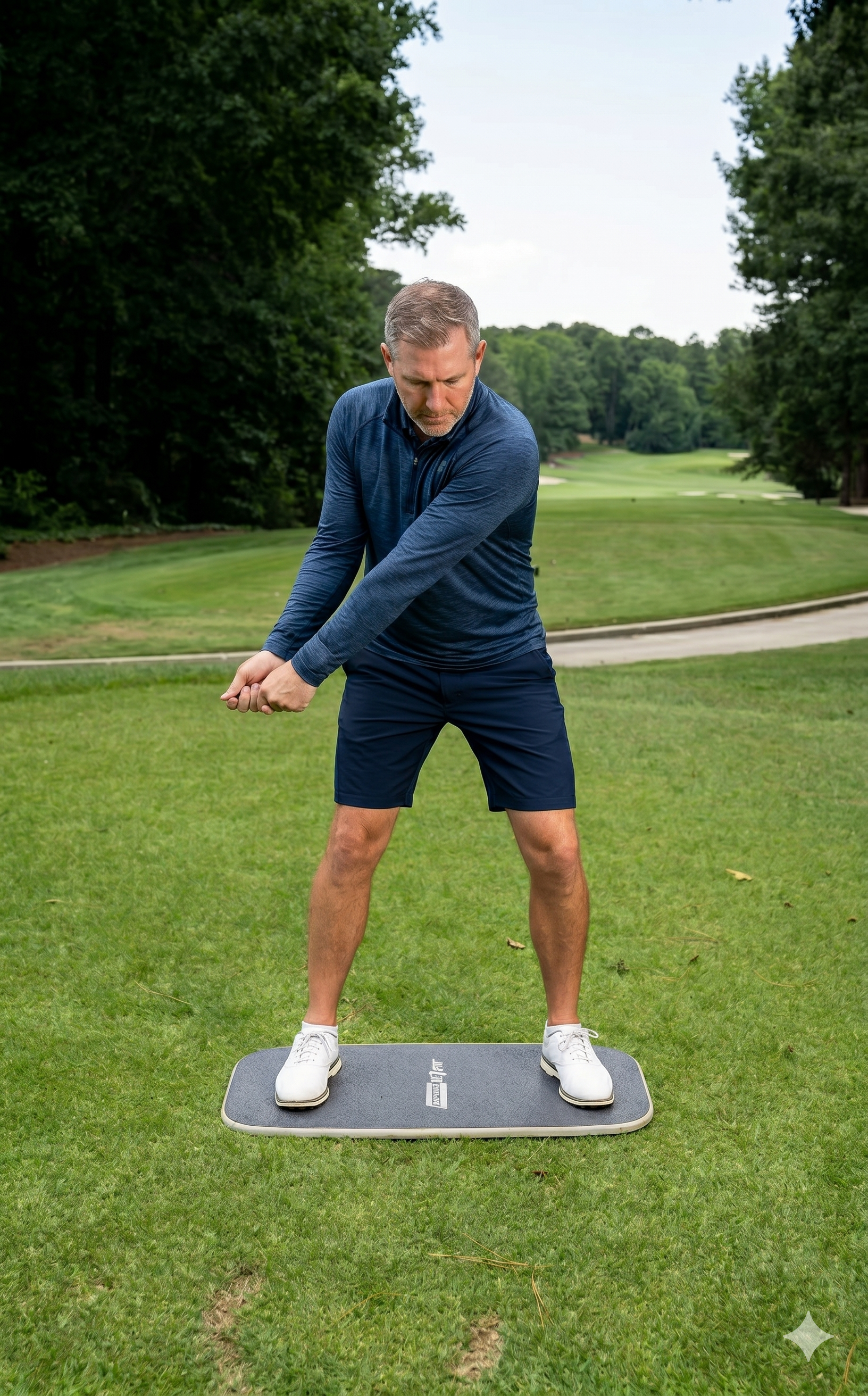
Makes pressure shift visible and trainable — coaches see results fast
Ease of Use: Simple Concept, Real Risks
✓ The Good: Plug-and-Play Setup
Setup is essentially zero: place the board on a stable surface, step on it, swing. No assembly, no app pairing, no calibration. The feedback is instant and physical — the board either tips or it doesn’t.
✗ The Risk: Easy to Misuse
The board can’t tell the difference between a true pressure shift and a lateral sway of body mass. Without coaching context, golfers risk ingraining the wrong movement pattern. No audio cue makes real-time awareness harder during a fast swing.
Surface Compatibility: Quick Reference
| Surface | Works? | Notes |
|---|---|---|
| Firm grass / range | ✅ Yes | Best natural surface — board sits and tips cleanly |
| Hitting mat (dense) | ⚠️ Conditional | Can slip — add non-slip pad or tape under dowel |
| Indoor turf / sim mat | ⚠️ Conditional | Slipping reported frequently — DIY fix required |
| Concrete / garage | ✅ Yes | Works well with a mat on top |
| Soft / wet grass | ❌ Limited | Dowel can sink and dampen feedback |
| Hardwood floor | ❌ No | Manufacturer explicitly warns against — can cause damage |
| Carpet | ❌ No | Same warning as hardwood floors |
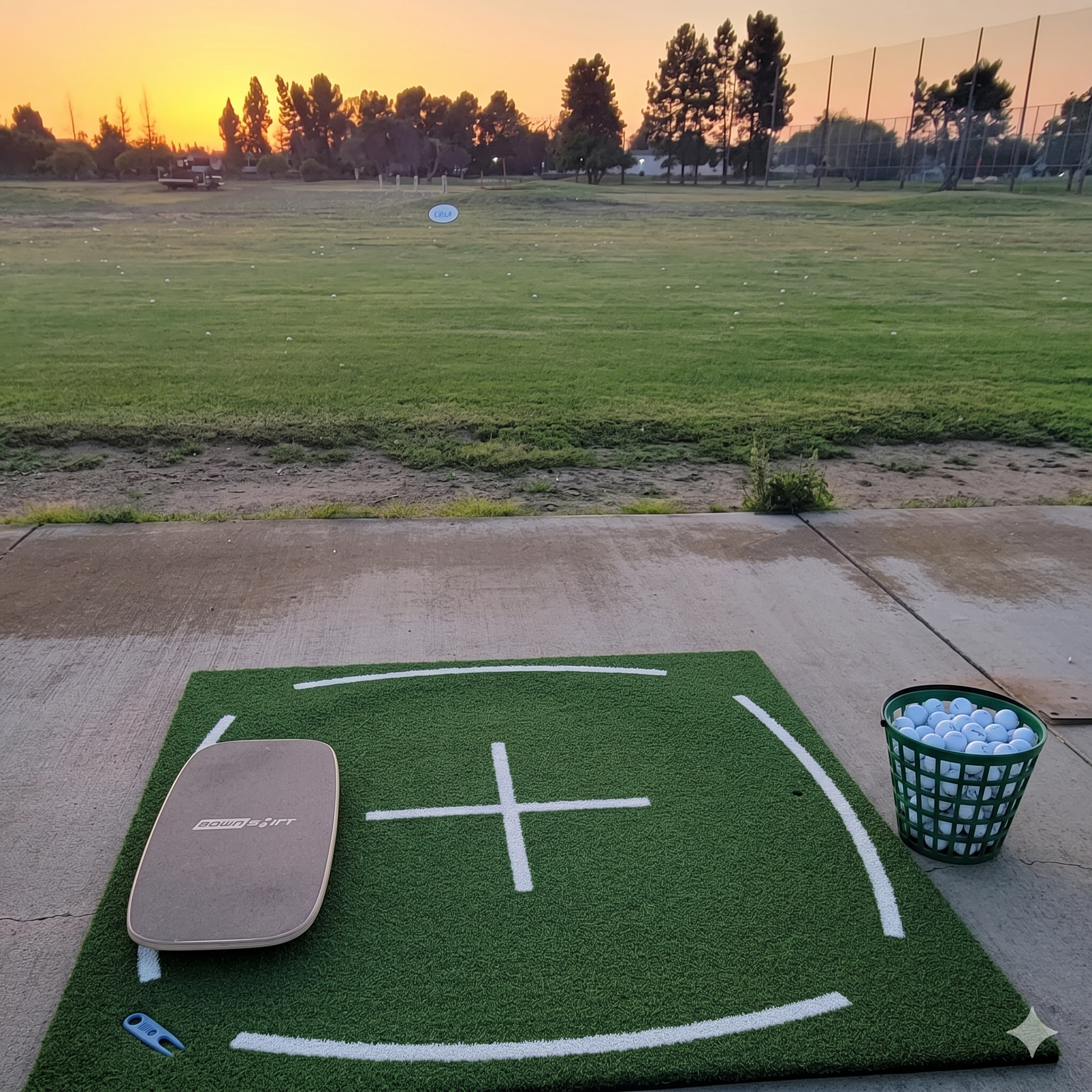
Concept is simple; risk of misuse and surface slipping drag this down
Value for Money: The Honest Conversation
$89 is the price. Let’s be honest about what you’re getting and what you’re not.
Compared to professional force plate systems (Swing Catalyst, BodiTrak — we’re talking $5,000 to $15,000+), the Downshift Board is an extraordinary bargain. It delivers the core feedback loop — did your pressure shift, and when — at a fraction of the cost. Coaches who use those professional systems regularly recommend the Downshift Board to their students for at-home practice. That’s meaningful validation.
💰 The DIY Question (Let’s Not Avoid It)
Reddit golf communities openly discuss building a functionally identical board from a 1×8 plank and a half-round dowel from a hardware store — total cost: $15–30. Some YouTube creators have tested DIY versions and found them comparable on pure function. If you’re handy and purely cost-conscious, the DIY path is real and well-documented.
Where the retail Downshift Board earns its premium: finished edges that won’t splinter, skateboard grip tape applied properly, the 2-year warranty, and access to Jeff’s post-sale drill content and personal follow-up. Those are real, if intangible, differentiators.
✅ You Should Buy If:
- • You practice regularly and genuinely struggle with pressure shift
- • You use a home simulator or mats where DIY doesn’t work
- • You value the warranty, polish, and founder follow-up
- • $89 is a reasonable training aid budget for you
❌ Skip It (Or DIY It) If:
- • You’re primarily motivated by curiosity or want to “try it out”
- • You’re comfortable at a hardware store and budget-conscious
- • You won’t commit to deliberate, high-volume repetitions
- • You expect an instant fix without drilling fundamentals
Outperforms its price vs. force plates, but the $20 DIY path is hard to ignore
Versatility: More Than a Full-Swing Tool
Real-World Applications
- ✓ Full swing pressure shift training (primary use)
- ✓ Chipping and pitching — stay on lead side through impact
- ✓ No-ball movement drills — garage, living room, backyard
- ✓ Pre-round warmup to groove pressure feel
- ✓ Post-lesson reinforcement of instructor guidance
Full swing, short game, dry drills — limited only by surface and floor type
Fairways & Hazards: The Honest Pros and Cons
Fairways (Strengths)
- ✓Immediate visual feedback — you see the tilt, you feel the shift
- ✓Works without hitting balls — garage, living room, backyard
- ✓Coaches rate it as an affordable substitute for $10K+ force plate systems
- ✓Unexpectedly effective for short game (chipping/pitching) — not just full swing
- ✓Founder’s post-sale support is genuinely exceptional — personal drill videos, fast follow-up
Hazards (Limitations)
- ✗Bottom dowel slips on smooth indoor turf and wet mats — fixable but annoying
- ✗Easy to misuse: swaying vs. genuinely shifting pressure look the same without guidance
- ✗A near-identical DIY version costs $15–30 — a real question for budget buyers
- ✗No audible feedback (unlike some competitors) — visual-only can be harder to process
FAQ: Your Downshift Pressure Board Questions Answered
What is the Downshift Pressure Board and how does it work?
The Downshift Pressure Board is a wooden rocker board that balances on a central dowel. When you stand on it and make your golf swing, the board physically tilts toward whichever side your weight — your center of pressure — is loaded onto. It gives you instant, real-time visual feedback on whether you’re shifting pressure correctly during your swing.
Who is the Downshift Pressure Board best for?
Mid-to-high handicappers (roughly 10–25 HCP) who struggle with reverse weight shift, hanging back on the trail side, or hitting fat/chunky iron shots. If your coach has ever told you that you’re not shifting your pressure early enough in the downswing, this board was made for you.
Does the Downshift Pressure Board work on indoor turf or golf simulator mats?
This is the board’s most reported frustration. The smooth bottom dowel can slip on dense indoor turf and slick hitting mats. Many users solve it by placing a grip mat underneath or adding non-slip tape to the bottom contact point. If your primary practice environment is a home simulator on smooth turf, be aware of this limitation before you buy.
Is the Downshift Pressure Board worth the price, or should I build a DIY version?
Honestly? Both options have merit. Reddit golf communities frequently point out that you can build a functionally similar board from a 1×8 plank and a half-round dowel from a hardware store for $15–30. If you’re handy and budget-conscious, the DIY route is well-documented. If you want a finished product with a 2-year warranty, grip tape, rounded edges, and access to the founder’s drill content and personal follow-up, the $89 retail version justifies the premium for most golfers.
What’s the difference between weight shift and pressure shift?
Weight shift (mass transfer) means moving your body mass side to side. Pressure shift is about where you’re pushing into the ground — and they’re not the same thing. You can sway your mass without changing ground pressure, which is actually a common fault. The Downshift Board trains pressure shift specifically: loading into the lead side before the backswing is complete, creating a ground reaction force that powers the kinetic chain.
Can I use the Downshift Pressure Board to practice my short game?
Yes, and this is one of the product’s underrated strengths. Several coaches use it specifically for chipping and pitching to train golfers to stay on their lead side through impact — a common fault in the short game. It’s not just a full-swing tool.
Will the Downshift Pressure Board damage my floors?
The manufacturer explicitly warns against using it on hardwood floors or carpet. The dowel bottom can scratch hardwood and the board’s weight can compress carpet unevenly. Stick to hitting mats, grass, or concrete garage floors with a mat underneath.
How long does it take to see results from the Downshift Pressure Board?
User reports suggest most golfers feel the correct pressure shift sensation within minutes of their first session. Sustainable improvement in ball-striking — the kind that transfers to the course — typically takes several weeks of deliberate repetition. One user who practiced consistently for a month described the movement starting to feel “second nature.” It’s not a magic fix, but the feedback loop is fast.
How does the Downshift Board compare to the WhyGolf Pressure Plate?
The WhyGolf Pressure Plate costs more (~$120–160) and uses ground spikes that theoretically anchor better on grass. However, Reddit users who have tried both report the WhyGolf version can dig too deeply into soft turf and feels impractical indoors. The Downshift Board is generally considered sturdier and offers a larger standing platform, which is an advantage for golfers with wider stances. The right choice depends on your primary practice surface.
Do I need a coach to use the Downshift Pressure Board effectively?
Not strictly required, but it helps significantly. The biggest risk without coaching guidance is mistaking a lateral sway (mass shift) for a true pressure shift. These look similar but produce very different results in your swing. If you don’t have access to a coach, pair the board with quality video instruction — the founder Jeff also provides drill content post-purchase via email and social media.
The Bottom Line: Who Should Buy the Downshift Pressure Board?
The Downshift Pressure Board does its core job remarkably well: it makes pressure shift — one of the most important and most misunderstood elements of a powerful golf swing — instantly visible and trainable without expensive technology. Coaches across multiple professional tours use it, and the real-world feedback from recreational golfers backs them up. For a mid-handicap golfer who hits behind the ball, hangs on their trail side, or simply can’t “feel” what their feet are doing during the swing, this board provides a feedback loop that verbal instruction and video analysis often can’t.
That said, this isn’t a plug-and-play fix. The surface slipping issue is real and requires a workaround. Without coaching context, there’s a genuine risk of ingraining a lateral sway instead of a true pressure shift. And at $89, the DIY alternative is hard to ignore for budget-conscious golfers. The overall score of 68/100 puts it squarely in “conditional buy” territory — not because it doesn’t work, but because the right conditions matter.
Best For
- ✓Mid-to-high handicappers (10–25 HCP) who’ve been told they’re “hanging back” or failing to transfer weight
- ✓Golfers who hit fat or thin iron shots and can’t diagnose why through video alone
- ✓Practitioners who want to train movement patterns without hitting balls — in the garage, living room, or backyard
- ✓Anyone working with a coach who can guide correct pressure shift vs. lateral sway
- ✓Golfers who practice on grass or a stable hitting mat
Skip These If:
- ✗Budget-conscious golfers who are comfortable at a hardware store — the DIY path is viable and well-documented
- ✗Home simulator golfers on smooth indoor turf without a plan to address the slipping issue
- ✗Golfers without any instruction context — the risk of ingraining a sway rather than a shift is real without guidance
- ✗Low handicappers with confirmed solid ground mechanics — you’re unlikely to get much you don’t already have
- ✗Anyone who practices exclusively on soft, sandy grass where the dowel can sink and dampen feedback
Final Scoring
| Category | Score | Max |
|---|---|---|
| Effectiveness | 25 | 30 |
| Build Quality & Durability | 16 | 20 |
| Ease of Use | 12 | 20 |
| Value for Money | 11 | 25 |
| Versatility | 4 | 5 |
| TOTAL | 68 | 100 |
⛳ The 19th Hole: Final Verdict
The Downshift Pressure Board makes the invisible visible — if you can't feel your pressure shift, this board will show you exactly where you're going wrong, fast.
Birdie Score: 68/100