Impact Snap Review (2026): Is This $99–$124 Release Trainer Worth It?
Birdie Score
Price
$99.00
One-Putt Summary
The Impact Snap (81/100) is one of the clearest, toughest indoor mechanical trainers for curing the amateur scoop, cast, and chicken-wing through dual audio and forearm-contact feedback—provided right-handed buyers get the $124.00 Combo with the Clubhead Attachment and pair dry reps with real hip rotation.
Fairways (Pros)
- ✓ Simultaneously teaches lead-wrist flexion, forearm supination, and ulnar deviation in one motion
- ✓ Instant binary feedback: internal steel weight clack paired with yellow ball forearm contact
- ✓ Compact ~16.2-inch indoor-safe profile (13.4 oz standalone / ~14.4 oz combo) fits standard 8-foot ceilings
- ✓ Bombproof Made-in-USA metal and molded rubber build with zero batteries, subscriptions, or wear pads
- ✓ Doubles as a quiet-wrist chipping and pitching drill when rotated a quarter-turn against the lead forearm
Hazards (Cons)
- ✗ Easy to cheat with static arm-only wrist rolls unless paired with deliberate hip and chest rotation
- ✗ Buying the $99.00 bare stick without the $25.00 Clubhead Attachment risks grooving a dead-shut hook face
- ✗ Loud internal metallic clack bothers roommates, spouses, and coworkers in shared offices or TV rooms
- ✗ Strictly a dry-swing rehearsal aid that cannot strike real or foam golf balls
- ✗ Fixed molded grip shape can pinch very large or small hands, and no left-handed Clubhead Attachment is sold on impactsnap.com
Best For
Chronic flippers, scoopers, and chicken-wingers seeking an indestructible, zero-setup indoor trainer to build forward shaft lean and proper release mechanics—especially right-handed golfers buying the $124.00 Combo with the Clubhead Attachment.
Impact Snap Review (2026): Is This $99–$124 Release Trainer Worth It?
An honest breakdown of the Made-in-USA wrist-release trainer invented by Kelvin Miyahira and owned by PGA teacher Marty Nowicki: verified specs, real owner outcomes, the $25 Clubhead Attachment catch, and how it compares to modern alternatives.
🏌️ One-Putt Summary
The Impact Snap is one of the clearest, toughest indoor trainers built for curing the amateur scoop, cast, and chicken-wing follow-through. Its sliding steel weight delivers a sharp metallic clack while its yellow cantilever ball taps your trail forearm—proving lead-wrist flexion, forearm supination, and ulnar deviation together. The catch: you cannot hit golf balls with it, the clack is loud around housemates, and the bare $99.00 stick makes it easy to groove a shut hook face. Buy the $124.00 Combo with the Clubhead Attachment and pair dry reps with hip rotation to earn its 81/100 Strong Buy score.
At a Glance: Impact Snap Scores
| Effectiveness | 25 | /30 |
| Value for Money | 19 | /25 |
| Build Quality & Durability | 19 | /20 |
| Ease of Use | 15 | /20 |
| Versatility | 3 | /5 |
| TOTAL | 81 | /100 |
Verdict: Strong Buy (81/100) — Elite Indoor Release Feedback (Get the $124 Combo)
Almost every amateur golfer battling weak, floaty irons shares the same impact flaw: the flip. Instead of delivering the clubhead with a flat lead wrist and forward shaft lean, the hands stall, the lead wrist cups, and the face scoops underneath the ball. Your 7-iron launches like a wedge, finishes short, and alternates between fat chunks and thin skulls.
Mental cues like “keep your hands ahead” rarely stick when impact happens in milliseconds. The Impact Snap attacks that problem mechanically. Invented around 2011 by biomechanics researcher Kelvin Miyahira and owned since 2015 by four-time PGA Section Teacher of the Year Marty Nowicki at Turning Stone Resort, this Made-in-USA trainer earned five consecutive Golf Digest Editors’ Choice awards (2016–2020) and remains a teaching-pro staple.
At $99.00 standalone ($124.00 compare-at) for right- or left-handed golfers—and $124.00 ($150.00 compare-at) for the right-handed Combo with the clip-on Clubhead Attachment—it asks real money for a ~16.2-inch dry-swing stick that cannot strike balls. Based on verified specs, Practical Golf’s review, published coach feedback, Amazon rating data, and owner reports on Reddit r/golf and MyGolfSpy, here is why it scores 81/100.
What Is the Impact Snap, and What Does It Claim to Do?
The Impact Snap is a pure mechanical release trainer—not a whippy tempo club, not a ball-striking mat, and not an electronic swing sensor. Its entire job is to train the exact wrist and forearm geometry that tour-caliber ball strikers produce between late downswing (delivery) and impact.
Most instructional clichés tell golfers to “hold the angle” or “pull the handle.” When amateurs try that literally, they drag an open clubface across the ball and slice it off the planet—or panic at waist height and throw the clubhead past their hands in a desperate flip. Miyahira’s research focused on what actually squares the face while maintaining forward shaft lean. Instead of passive handle-dragging, great strikers combine three simultaneous wrist and forearm movements right through impact:
- Lead Wrist Flexion (Trail Wrist Extension): Bowing or flattening the lead wrist while keeping the trail wrist bent backward—delofting the iron slightly so you compress the ball instead of scooping it.
- Lead Forearm Supination (Trail Forearm Pronation): Rotating the lead forearm counter-clockwise (for a right-hander) through the strike so the clubface squares naturally and the lead arm extends without buckling into a “chicken wing.”
- Ulnar Deviation: Unhinging both wrists downward toward the golf ball so the clubhead releases its stored radial lag down into the turf rather than staying stuck up in the air.
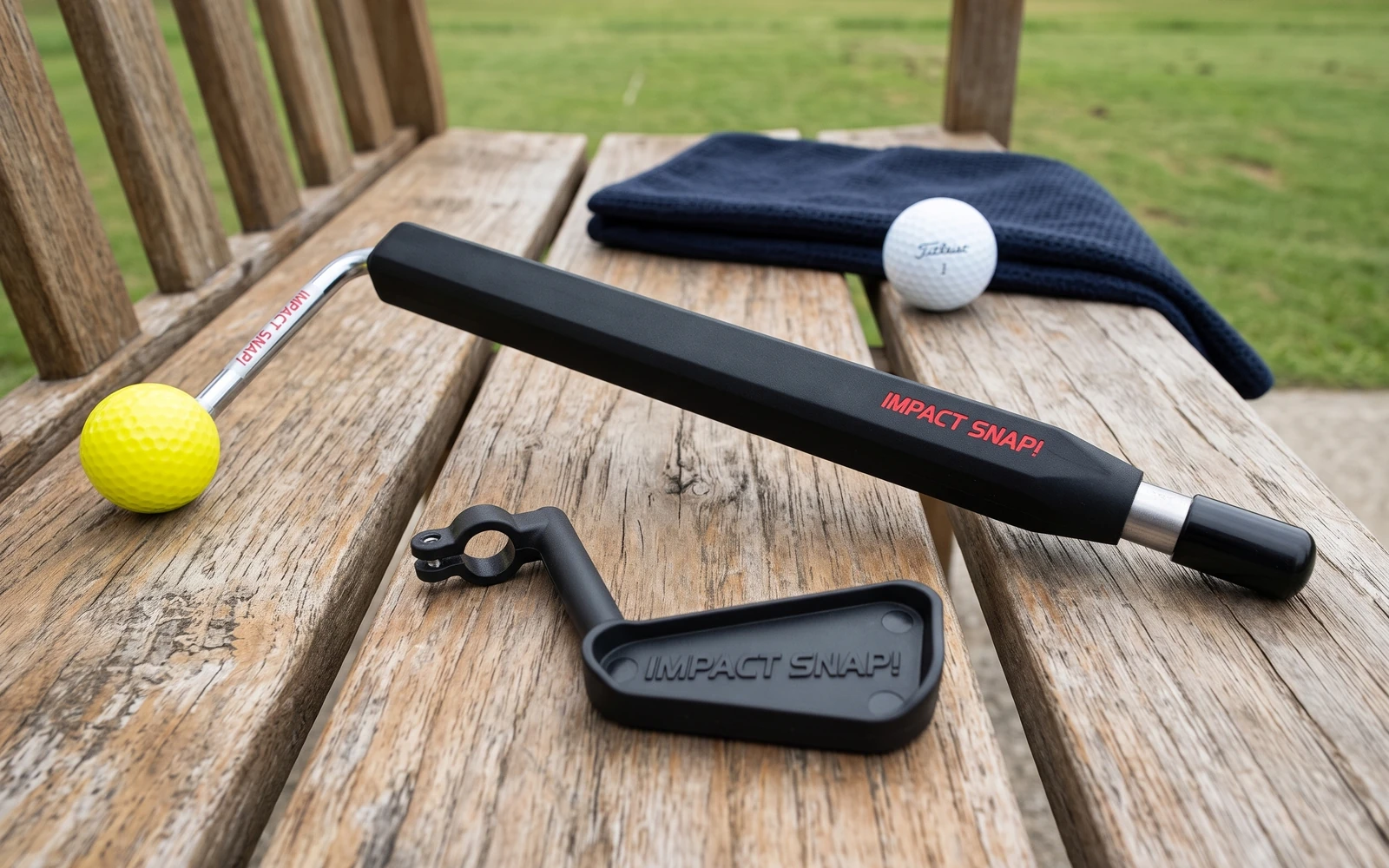
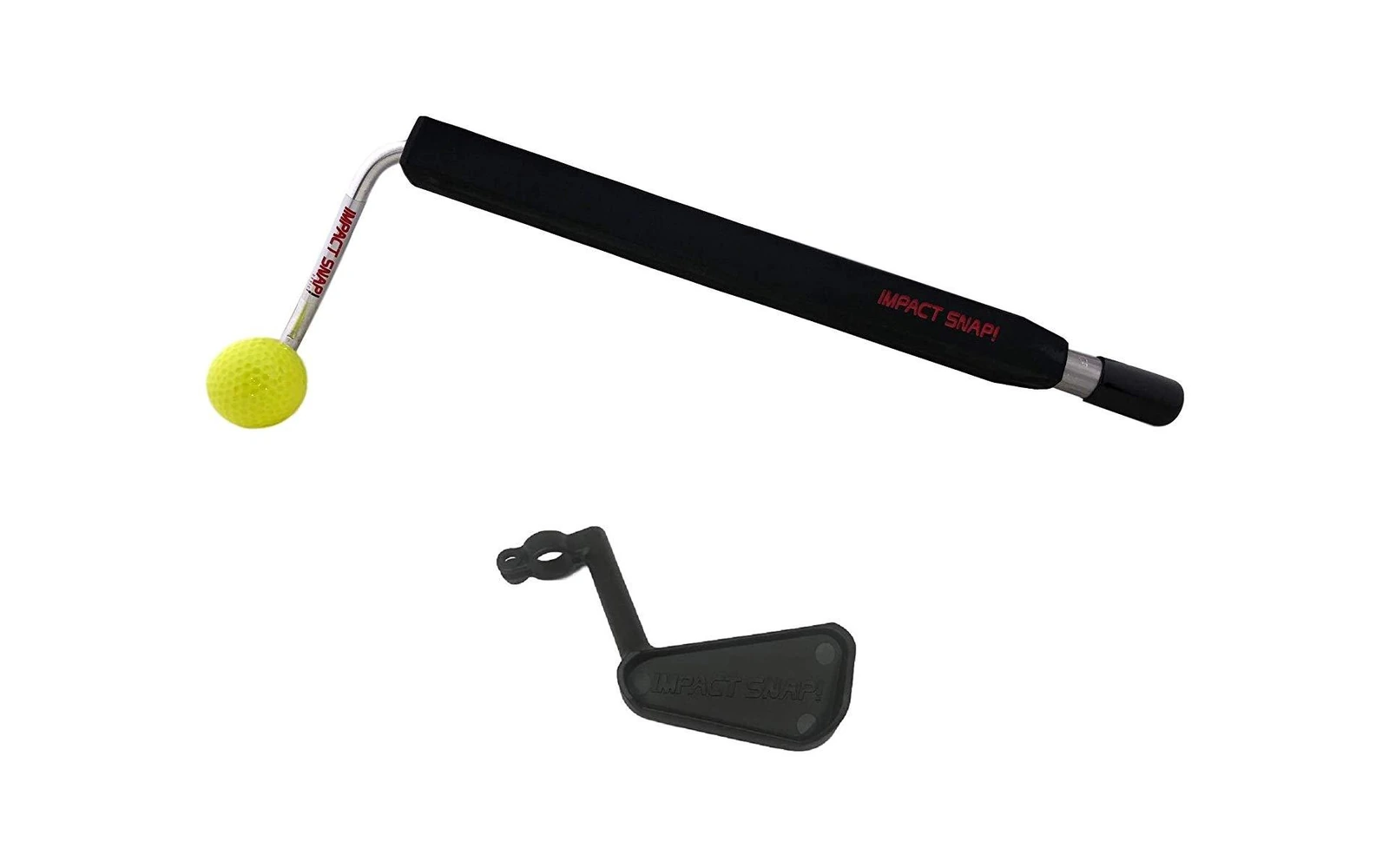
Inside the Impact Snap’s hollow metal barrel sits a free-sliding stainless steel weight cylinder. Extending from the butt end is a bent chrome steel cantilever arm tipped with a neon-yellow dimpled ball (~1.68 inches across). Execute the release cleanly and two things happen together at impact: the internal cylinder slams to the distal stop with a sharp metallic “CLACK”, and the yellow ball taps the inside (ulnar side) of your trail forearm.
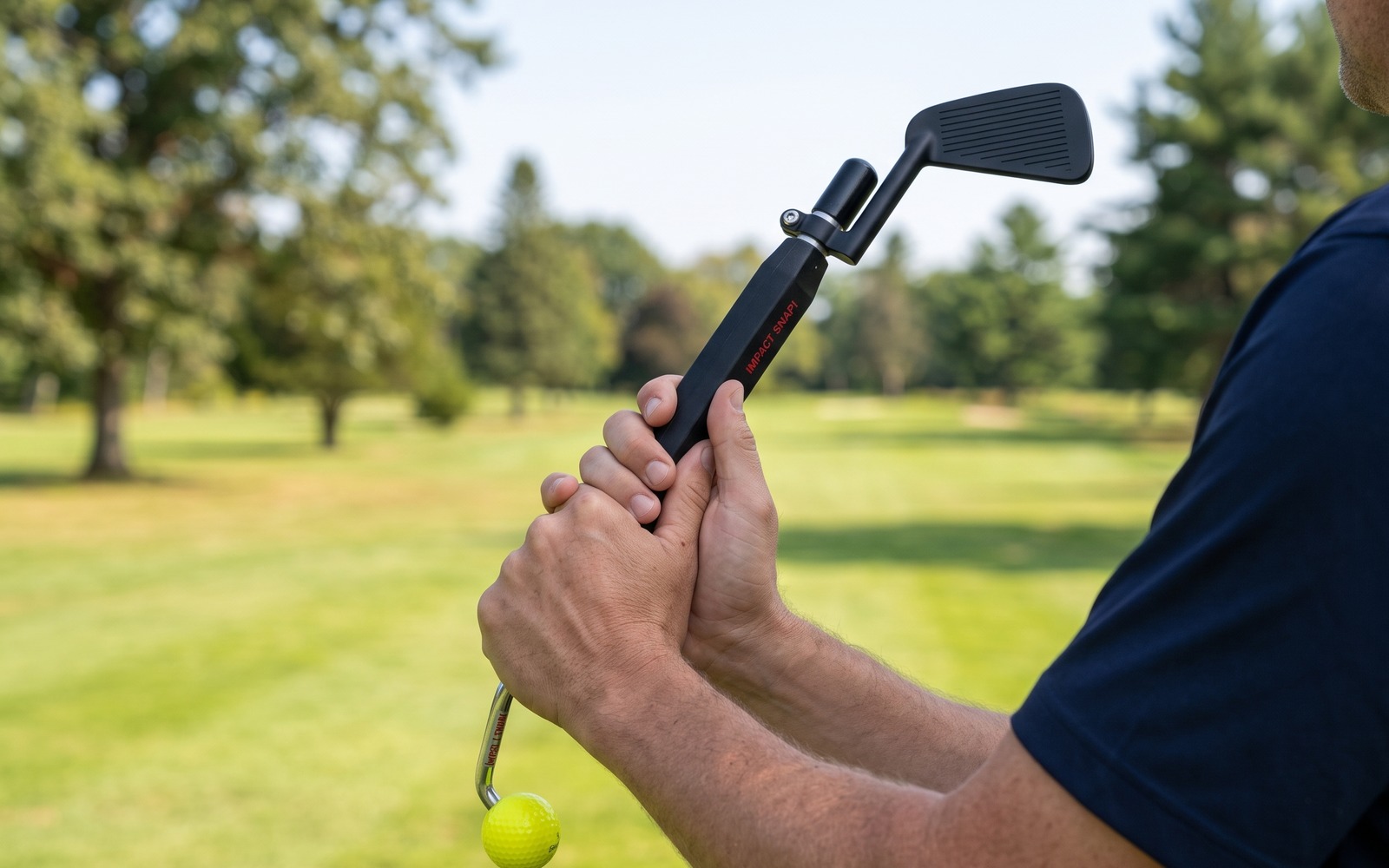
Bolt the optional 28-gram polymer Clubhead Attachment onto the exposed silver neck above the black rubber tip cap, and you gain a grooved iron blade with 10 to 11 horizontal scoring lines so you can verify a square clubface at impact.
📋 Hardware Specifications & Official Pricing
*Catalog Note: The official impactsnap.com Shopify page currently displays a “2 x 2 x 46 inches” typo in its product body text. The real Impact Snap is a compact ~16.2-inch handheld trainer built for standard ceilings, not a 46-inch driver shaft.
Buying Trap: Skip the $99.00 bare stick if you swing right-handed. Without the $25.00 Clubhead Attachment, it is easy to clack the weight and touch your forearm by shutting the face 20 degrees closed. Note that impactsnap.com currently lists the attachment in right-handed only. Prefer live-ball club feedback instead? See our WhyGolf Wrist-X review or HackMotion breakdown.
How to Read the 6 Core Impact Snap Feedback Checkpoints
1. Tour-Level Release (Ideal Impact)
Your hips and chest clear toward the target, the internal steel weight clacks crisply at the bottom of the arc, the yellow ball taps the inside of your trail forearm, and the grooved Clubhead Attachment face points squarely down the target line.
2. Early Cast (Premature Clack)
The sliding weight slams down at the top of the backswing or halfway down in transition before your hands approach impact—instant audio proof that you dumped wrist lag early from the top.
3. The Scoop / Flip Miss
The weight clacks near the bottom, but your lead wrist cups backward to “help” the ball up. The yellow ball swings out into empty air several inches off your trail forearm—a clear fail on the tactile check.
4. The Dead-Shut Hook Face
The yellow ball hits your forearm and the clack sounds great, yet looking down at the Clubhead Attachment reveals the grooved face aimed steeply left (for a righty). You cheated the forearm tap by shutting the face instead of supinating properly.
5. The Static Arm-Only Cheat
Standing flat-footed with zero pelvic rotation, you can roll your forearms lazily and force the yellow ball against your trail arm. It passes the hardware test in your living room while grooving an arm-only flip that fails on real grass.
6. Short-Game Chipping Mode
Rotate the grip a quarter-turn so the yellow ball sits against the inside of your lead forearm. Keeping the ball lightly pinned there through a short back-and-through stroke quiets wristy chips and pitches around the green.
Build Quality & Durability: Built Like an Industrial Shop Tool
When you pay triple digits for a training aid that fits inside a small box, the first question is always whether it feels like $124 worth of hardware or $12 worth of brittle plastic. On build quality, the Impact Snap clears the bar effortlessly.
Assembled in Syracuse, New York—with production overseen by Joe and Sal Giancarelli alongside engineering advisor Dr. David Wellenstein—the trainer weighs a reassuring 13.4 ounces (380 grams) on its own and roughly 14.4 ounces (408 grams) once you bolt on the 28-gram Clubhead Attachment. That compact density gives the short stick real club-like heft in your hands rather than feeling like a hollow toy.
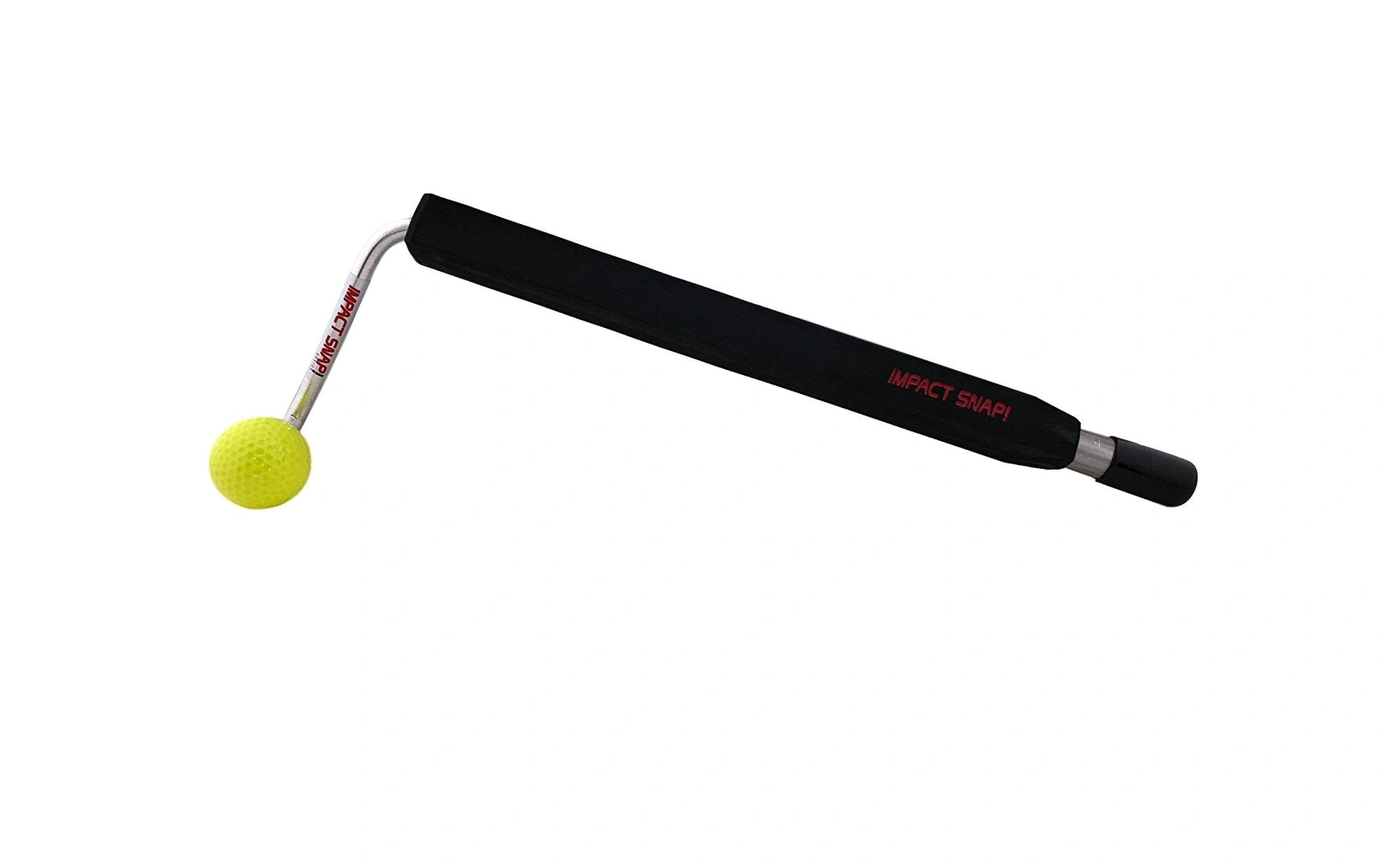
Starting from the grip, you hold a thick, matte-black molded rubber training grip with subtle flat bevels and finger-placement contours that guide a neutral-to-strong golf grip. Near the bottom taper sits the slanted crimson IMPACT SNAP! wordmark. Extending from the grip’s distal end is roughly 1.5 inches of exposed brushed stainless steel barrel (stamped with a tiny “R” on right-handed units) capped by a satin black rubber tip.
At the top butt end, a sturdy ~3/8-inch chrome-plated steel cantilever rod exits axially, makes a smooth 90-degree bend, and runs laterally for several inches to a dense, neon-yellow dimpled contact ball. The straight section of that chrome arm carries the silver-and-red IMPACT SNAP! DEVICE decal. Unlike elastic swing aids that stretch out after a summer in the trunk or sequin strike pads like The Divot Board that shed under sharp wedge grooves, there is virtually nothing on the core Impact Snap body to wear out, fray, or break.
Why It Scores 19/20 Instead of Falling Off Like Electronic Trainers: Electronic wrist and swing sensors such as Blast Motion Golf or HackMotion rely on lithium batteries, Bluetooth pairing, firmware updates, and tight silicone sleeves. The Impact Snap has zero charging cables, zero app subscriptions, and zero firmware to glitch out five years from now. Its single moving part is a solid steel cylinder sliding inside a metal tube.
The only reason Build Quality stops at 19 out of 20 rather than a full 20 is the Clubhead Attachment mounting interface and finish longevity. The matte-black molded polymer clubhead attaches via a split C-clamp collar tightened by a small stainless steel socket-head screw and nut. Installation takes roughly 30 seconds, and once cinched down on the exposed silver neck between the grip taper and the rubber tip cap, it stays solid during dry swings—though it can rotate out of alignment if you smack a chair leg or drop it carelessly in a crowded trunk. Likewise, the rubber tip cap and arm sticker will show cosmetic scuffs if banged against concrete garage floors, and per the official FAQ page, Impact Snap covers defective units with a replacement (plus return postage) but only offers a 30-day return window rather than a multi-year lifetime guarantee.
💡 Pro Tip: Lock the Clubhead Alignment Before Every Session
When bolting on the Clubhead Attachment, align the flat grooved face dead square to the flat thumb bevel on top of the molded grip—never eyeball it crookedly—and tighten the clamp screw snugly so it cannot twist mid-swing. Give the silver neck clamp a quick finger check every week or two if you toss the trainer into a golf bag pocket or car trunk.
Build Quality & Durability Score
Made-in-USA machined metal tube, molded grip, and rigid steel cantilever arm have virtually zero wear parts; minor point off for clamp-bolt alignment checks
Effectiveness: Does It Actually Cure Casting and the Flip?
For a non-electronic training aid, the Impact Snap’s biomechanical premise is remarkably sound. Most swing gadgets target only one plane of motion—either backswing width like the GravityFit TPro, arm connection like the Tour Striker Smart Ball, or simple wrist extension/flexion via a clicker like the WhyGolf Wrist-X. The Impact Snap forces all three release mechanics—lead-wrist flexion, lead-forearm supination, and ulnar deviation—to happen in concert.
Because the yellow ball sits on an offset rod protruding behind your lead hand, you physically cannot touch the inside of your trail forearm at impact by flipping. Try to scoop the trainer with a cupped lead wrist, and the chrome arm kicks the yellow ball out into thin air inches away from your skin. As Golf Digest‘s Ashley Mayo explained in a review quoted verbatim on Impact Snap’s official press and terms page: “Impact Snap uses a simple combination of sound and feel to promote the right movement of the hands and arms through the ball. You can immediately sense when you’re performing the motion correctly.”
That dual audio-tactile feedback loop has won over a deep bench of top instructors. On Impact Snap’s reviews page, Hank Haney calls it “one of my favorite Training Aids,” Bobby Clampett describes it as “one of the best tools to come around in a long long time to help you produce dynamic impact,” and 55-year PGA veteran Charlie Cowan puts it bluntly: “It works. I have taught golf for fifty five years and this device stands alone.” Canadian coach Shawn Clement adds that he loves how it “really encourages the natural release of the anatomy of the arm-club unit.”
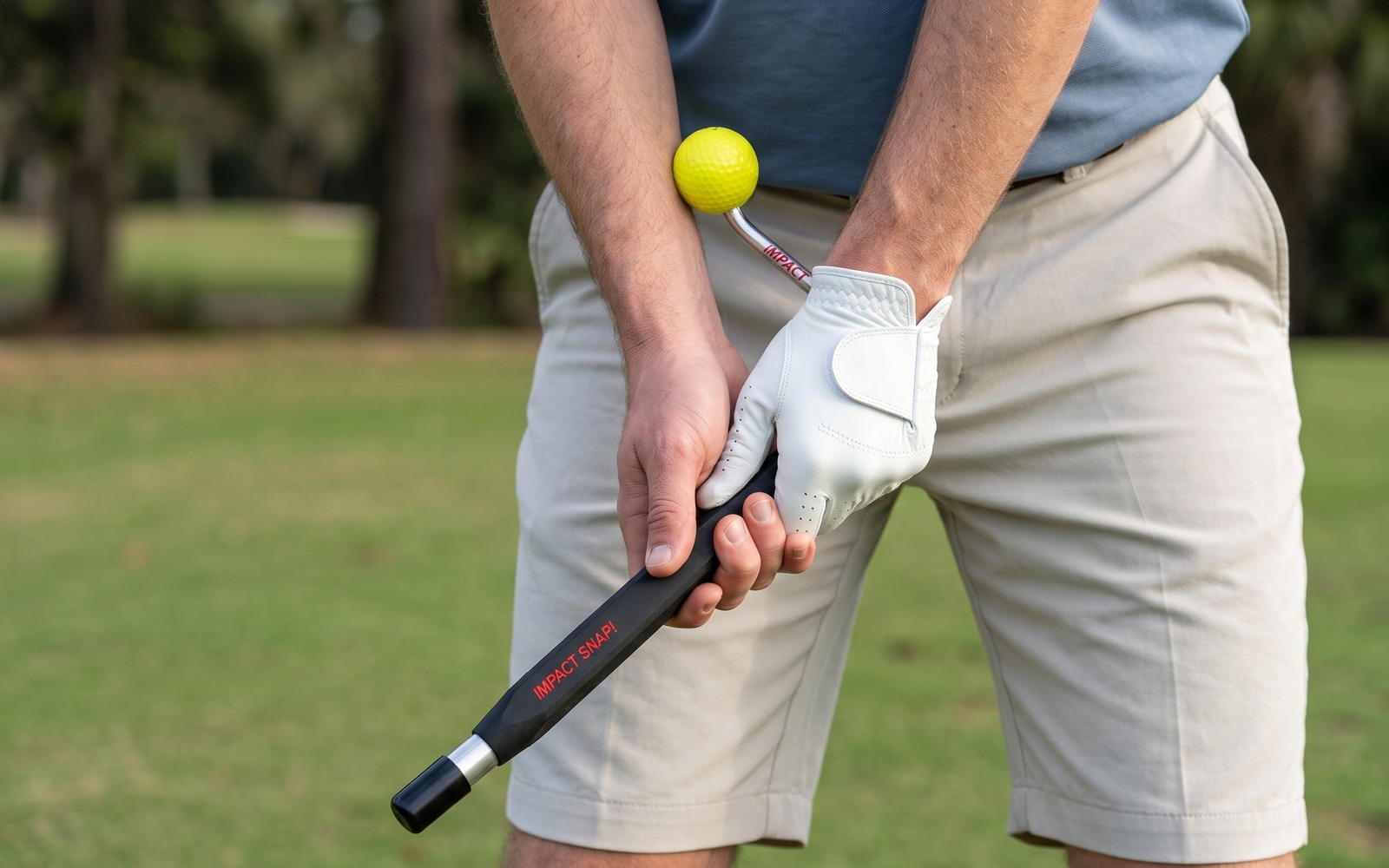
Real Owner & Independent Reviewer Validation: In Practical Golf’s full review, the author highlights why the device earned industry staying power—noting not only its full-swing release cue, but also its bonus value for chipping when you rotate the grip a quarter-turn so the yellow ball rests against your lead forearm to eliminate flippy short-game wrists. On the manufacturer’s customer ledger, 69-year-old Connecticut golfer David Howes reported swinging his Impact Snap 50 to 80 times a day for nearly a year and dropping his handicap from 12 down to 8.5, while Oregon owner Richard VanCleave credited it with back-to-back rounds of dramatically straighter, longer tee and approach shots, and New York golfer Dave Critelli reported achieving cleaner 9-iron strikes immediately after just two minutes of guided reps.
Three Real Limitations That Hold Effectiveness Back
So why doesn’t the Impact Snap score a 29 or 30 out of 30? Across teaching pros, Practical Golf, and candid golf forum threads on Reddit r/golf and MyGolfSpy, three legitimate effectiveness catches show up over and over:
- You Can Cheat the Motion Without Body Pivot: This is the number-one instructor critique. Stand flat-footed, freeze your hips and chest, and simply roll your wrists and forearms in front of your belt buckle—the internal weight still clacks, and the yellow ball still smacks your trail forearm. Unless you consciously pair every rehearsal with proper hip clearance and weight transfer toward your lead foot, you can train a slick living-room wrist roll that turns into a snap-hook on the golf course.
- The Bare Stick Encourages a Dead-Shut Clubface: Without the $25.00 Clubhead Attachment bolted onto the silver neck, golfers routinely over-bow their lead wrist just to force the yellow ball onto their forearm. On Reddit r/golf, owners repeatedly caution that practicing blindly without the visual clubface alignment lines makes it easy to ingrain a closed clubface that produces screaming low hooks once you grab a real 7-iron.
- The Dry-Stick-to-Live-Ball Transfer Gap: Swinging a 16.2-inch, 14.4-ounce stick with no golf ball on the ground feels much easier than delivering a 37-inch 7-iron at 85 mph into a real Titleist. Practical Golf also notes a realistic behavioral risk: some golfers—especially better players—try the Impact Snap a few times, get bored of dry swings without ball-flight feedback, and park it in a closet before motor habits actually stick.
🛠️ The 3-Step Drill Sequence That Prevents “Living-Room Hooks”
To make indoor Impact Snap reps translate to real turf, use a three-stage progression: (1) Static P6 Checkpoint: Take the club back to shaft-parallel (waist height), pause, then rotate your chest and lead hip open as you bow your lead wrist so the weight clacks and the yellow ball taps your trail forearm with the Clubhead Attachment square. (2) Half-Swing Pump: Make waist-high to waist-high swings focusing on hearing the click in front of your trail thigh, never behind it. (3) Immediate Real-Club Bridge: After 15–20 Impact Snap reps, pick up an actual 8-iron or wedge—or a live-ball trainer like the Lag Shot 7-Iron or The Strike Wedge—and rehearse the exact same wrist-and-pivot feel with a real ball.
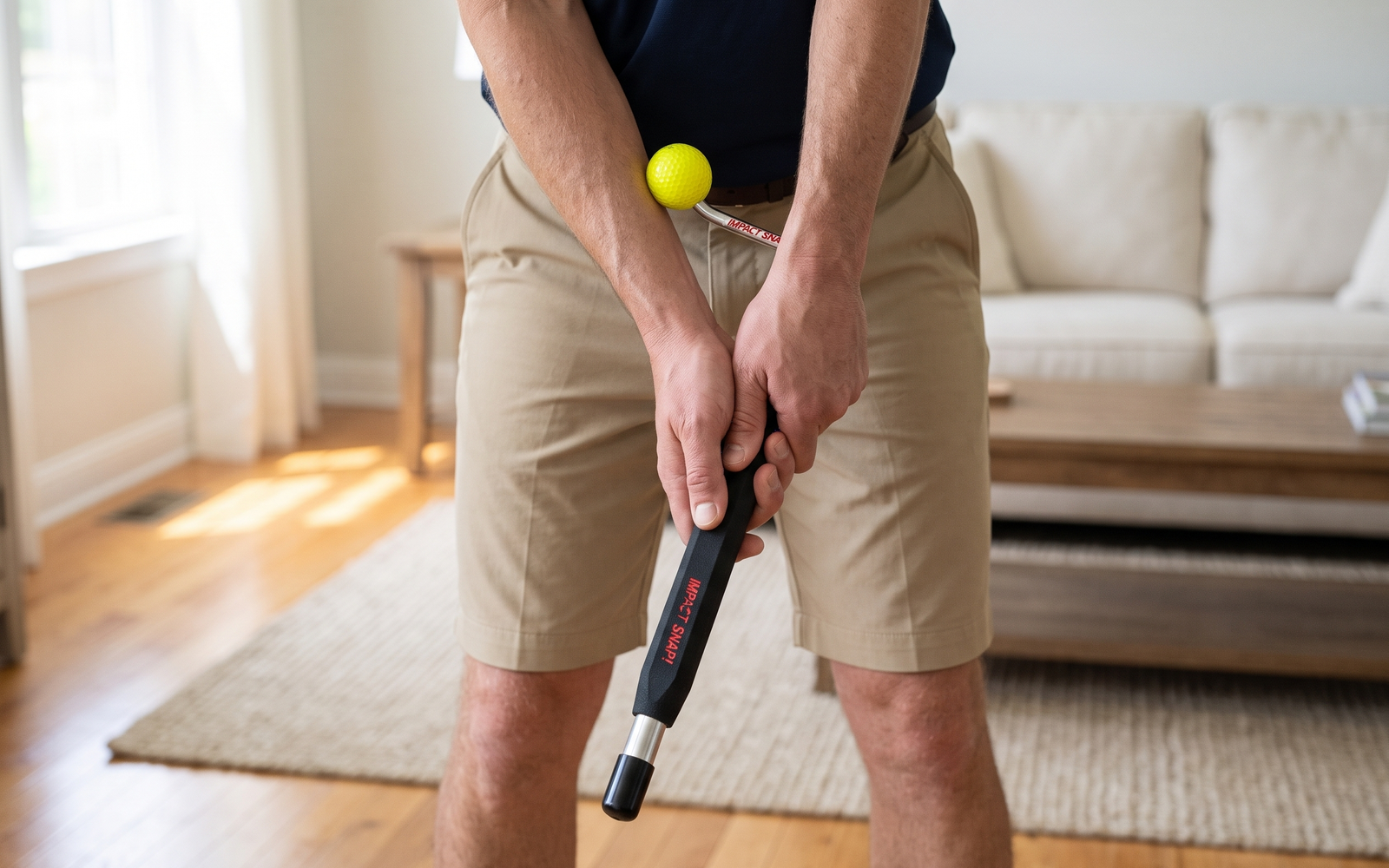
Effectiveness Score
Brilliant dual audio-tactile proof of flexion, supination, and ulnar deviation; docked 5 points for arm-only cheating risk, dry-only transfer gap, and needing the attachment for face control
Ease of Use: Zero Setup Friction, But Bring Earplugs to the Office
From a convenience standpoint, the Impact Snap solves the biggest hurdle in golf practice: friction. Driving to the range costs time and bucket fees, and swinging a full-length 7-iron indoors risks taking out a chandelier or drywall. Because the Impact Snap’s straight body measures roughly 16.2 inches (~17 × 7 × 2 inches overall), you can keep it leaning beside your desk or couch and knock out 30 quality motor reps between phone calls under standard 8-foot ceilings.
Every purchase also includes access to Impact Snap’s free 7-day video training program and a printable two-page instruction sheet on impactsnap.com’s FAQ portal, so beginners aren’t left guessing how to set their wrists at the top or rotate for short-game chipping drills. No batteries, no Bluetooth pairing, no tripods, and zero alignment mats are required.
⚙️ Real-World Usability Friction Worth Knowing About
✓ What makes daily reps effortless:
Compact ~16.2-inch length fits inside any golf bag pocket, carry-on suitcase, or home office; zero electronics or calibration; instant pass/fail audio + forearm feedback in under 60 seconds.
✗ Three practical quirks that annoy owners:
First, that internal steel cylinder makes a surprisingly loud metallic clack—Reddit r/golf owners regularly joke (and warn) that snapping it 50 times in a living room drives spouses, roommates, and office coworkers crazy. Second, the molded grip is a fixed ergonomic shape with raised contours; golfers with extra-large hands, very small hands, or stiff joints often prefer a traditional round Tour Velvet feel (or an unattached clip-on like the G-Rip Grip Trainer). Third, Impact Snap is strictly hand-specific—right-handed and left-handed units cannot be shared across opposite-handed players, and the Clubhead Attachment is listed in RH only.
One more physical detail for players with sensitive joints: because the internal stainless steel cylinder stops sharply against the distal metal plate, aggressive rapid-fire snapping transmits a brisk metallic shock down the shaft into your lead wrist. Taking deliberate, rhythmic swings—especially during slow-motion P6-to-P7 checkpoints—is gentler on your wrists and teaches better sequencing anyway than whipping it furiously like a speed stick.
Practice Environment Compatibility Guide
| Practice Setting | Compatibility | Real-World Setup Notes |
|---|---|---|
| Home Living Room / Garage | ✅ Excellent | ~16.2″ length clears standard 8-foot ceilings easily; just warn family members about the sharp metallic clack during TV time. |
| Private Office / Remote Desk | ✅ Very Good | Easy to keep beside your chair for 2-minute midday reps, though far too loud for open cubicles or unmuted Zoom calls. |
| Outdoor Driving Range (Dry Pre-Shot) | ✅ Very Good | Great as a 5-rep rehearsal before hitting real irons with a grooved club; never try to strike a real ball with the Impact Snap. |
| Travel / Hotel Room / Carry-On | ✅ Excellent | At ~14.4 oz (combo) and ~17″ × 7″ × 2″, it slips into a suitcase or golf travel bag effortlessly for pre-round warmups. |
| Live-Ball Range or Simulator Bay | ❌ Not Applicable | Strictly a dry-swing mechanical trainer; cannot hit foam or real golf balls without risking damage to the tip cap or polymer clubhead. |
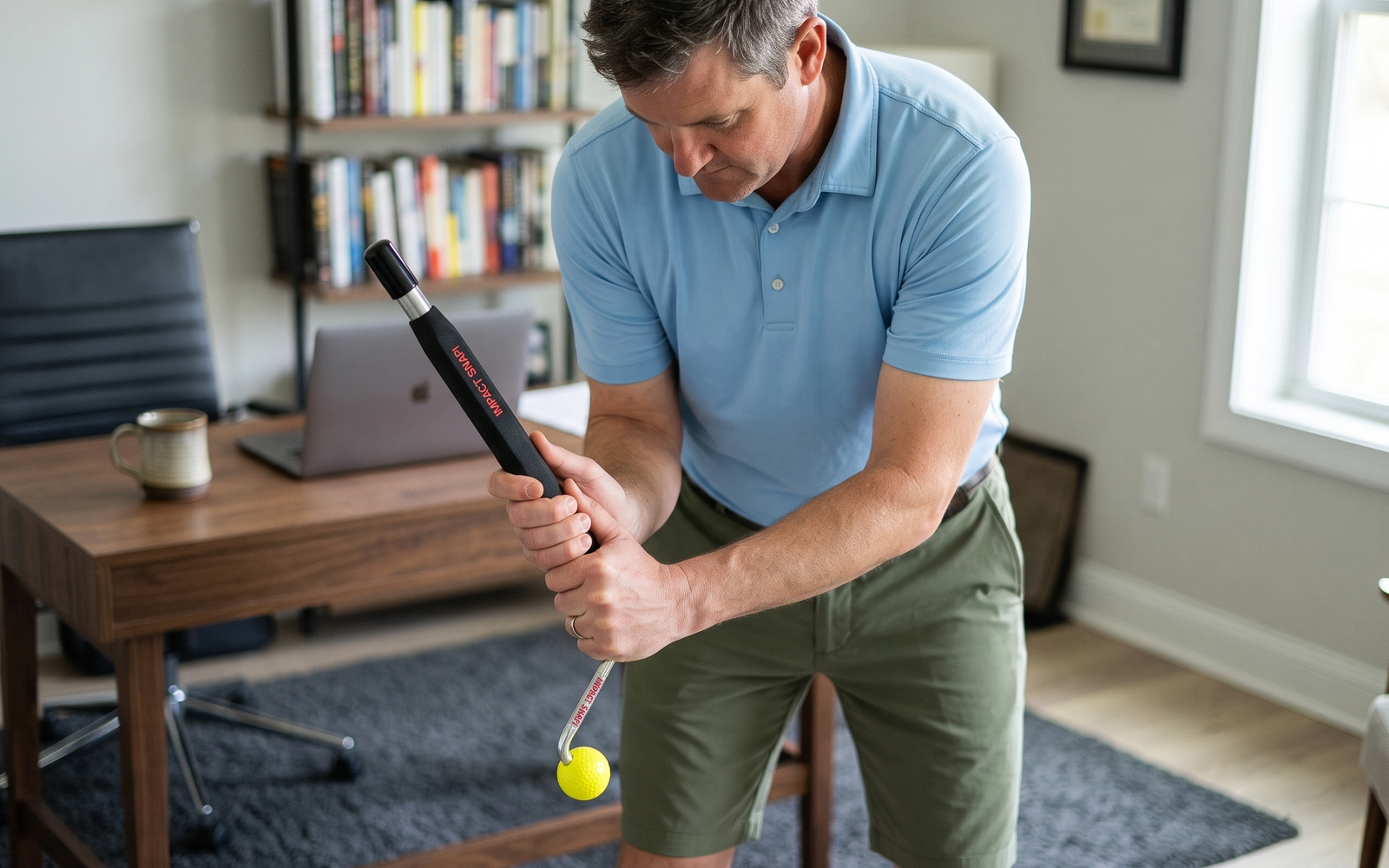
Ease of Use Score
Zero setup, indoor-safe ~16.2″ footprint, and clear video drills; docked 5 points for loud clack noise, fixed molded grip sizing, and RH/LH handedness lock
Value for Money: Should You Spend $124 on a 16-Inch Metal Stick?
Value is the classic sticking point in Impact Snap discussions. On impactsnap.com (as well as authorized partner Mike Bender Golf Products), the standalone right-handed or left-handed Impact Snap sells for $99.00 (marked down from a $124.00 compare-at price) with free USA shipping. Adding the Clubhead Attachment brings the Combo pack to $124.00 (down from $150.00 compare-at), while buying the attachment separately runs $25.00. Third-party Amazon combo listings tracked by GolfSim.co sit higher at roughly $134.99 (holding a solid 4.1-star average across 214 ratings), while direct international orders run $150.00 USD shipped and instructors can buy a 10-pack for $750.00.
Looking strictly at raw materials, plenty of Reddit r/golf shoppers grumble that $124.00 feels steep for a 16-inch aluminum/steel barrel, a rubber grip, a bent chrome rod with a yellow foam ball, and a 28-gram plastic clubhead. That criticism is fair—especially because the $25.00 Clubhead Attachment really ought to come standard in the box instead of functioning as a nearly mandatory paid add-on.
Yet stack that $124.00 Combo against the rest of the wrist-and-release category, and the value equation flips quickly. It costs roughly one-third to one-eighth of an electronic sensor like HackMotion ($295–$995+), carries zero annual subscriptions like Blast Motion’s $99/year membership, requires zero $49.99 replacement pads like The Divot Board, and still runs less than a single one-hour session with a top local PGA instructor—while lasting indefinitely.
Head-to-Head Value Comparison: Impact Snap vs. Top Release & Wrist Trainers
| Training Aid | Street / Retail Price | Ongoing Cost | Core Mechanism | Best Strength vs. Impact Snap |
|---|---|---|---|---|
| Impact Snap (+ Combo) (Birdie Score: 81/100) |
$99.00 standalone / $124.00 Combo | $0.00 (no batteries or pads) | Internal sliding weight clack + yellow forearm contact ball + clamp-on face | Simultaneously verifies flexion, supination, ulnar deviation, and face angle indoors. |
| WhyGolf Wrist-X | ~$100.00 | $0.00 | Club-mounted forearm contact clicker | Clips onto real clubs so you can hit live range balls, though it lacks the supination ball cue. |
| HackMotion Sensor | $295.00–$995.00+ | $0.00 (tier-locked features) | 3D electronic wrist-angle IMU + app audio | Measures exact wrist flexion/extension degrees on live swings, at 2.5x–8x the price. |
| Tour Striker Smart Ball | ~$47.00 | $0.00 | Inflatable lanyard ball between forearms | Less than half the price and works on live wedge/iron shots, but trains arm structure rather than wrist release. |
| SKLZ Tempo & Grip Trainer | ~$40.00 | $0.00 | Short weighted club with molded grip | Cheaper warmup/grip tool for the house, with no dynamic release clack or forearm feedback. |
| Lag Shot 7-Iron | ~$119.00 | $0.00 | Ultra-flexible ~20–30 cpm live-ball 7-iron | Similar price and hits real golf balls to cure rushed transitions, though unusable inside a living room. |
Bottom line: buying the $124.00 direct Combo from impactsnap.com gives chronic flippers high feedback-per-dollar—provided you log 50 daily dry reps for a month rather than parking it in a closet.
Value for Money Score
$124 Combo isn’t cheap for dry-only hardware and the $25 attachment feels like a hidden tax, yet lifetime durability and zero subscriptions beat pricier sensors
Versatility: Indoor Dry-Swing Specialist With a Short-Game Bonus
The Impact Snap earns a realistic 3 out of 5 on versatility because it makes no pretense of being an all-in-one swing system. You cannot hit golf balls on the range with it, you cannot putt with it like a sensor or rail, and it won’t fix backswing sway, stance width, or posture on its own the way a dedicated pivot aid like LagMaster or an alignment rig does.
Where it earns that third point above a purely one-trick stick is two-fold. First, its ~16.2-inch travel footprint lets it work anywhere—carpeted bedrooms, garages, hotel rooms, or a pre-round grass warmup beside your bag. Second, as Practical Golf highlighted, rotating the molded grip a quarter-turn switches the drill from full-swing release to a quiet-wrist chipping and pitching rehearsal against your lead forearm—giving high-handicappers who flip wedge chips around the green a clean second drill without buying another gadget.
Versatility Score
Strictly dry-swing rehearsal with zero live-ball capability, boosted slightly by travel portability and the quarter-turn short-game chipping drill
Fairways & Hazards: The Honest Pros and Cons
Fairways (Strengths)
- Simultaneously teaches lead-wrist flexion, forearm supination, and ulnar deviation—the complete three-part impact triad rather than a single-plane cue
- Instant binary pass/fail feedback: metallic internal clack proves timing while the yellow ball tapping your trail forearm proves release geometry
- Compact ~16.2-inch footprint and 13.4 oz weight (14.4 oz combo) let you groove 50–80 reps a day indoors under standard 8-foot ceilings
- Bombproof Made-in-USA construction with zero batteries, zero Bluetooth pairing, zero subscriptions, and zero consumable wear pads
- Doubles as a quiet-wrist chipping and pitching trainer when rotated a quarter-turn against your lead forearm
Hazards (Limitations)
- Easy to “cheat” with static, arm-only wrist rolls if you fail to rotate your hips and chest through the simulated impact zone
- Buying the $99.00 bare stick without the $25.00 Clubhead Attachment risks ingraining a dead-shut 20-degree closed hook face
- Surprisingly loud internal steel clack bothers office coworkers, roommates, and TV-watching family members during long indoor sessions
- Strictly a dry-swing rehearsal aid—cannot hit real or foam golf balls, leaving a transfer gap up to full-speed iron swings
- Fixed molded grip contours can feel awkward for very large, very small, or arthritic hands, and no left-handed Clubhead Attachment is sold on impactsnap.com
Who Should (and Shouldn’t) Buy the Impact Snap
Best For:
Chronic flippers, scoopers, and “chicken-wing” ball strikers who cast the club early from the top, hit weak high irons with inconsistent low-point contact, and want an indestructible, zero-setup indoor trainer for daily living-room or garage rehearsals—especially right-handed golfers willing to buy the $124.00 Combo with the Clubhead Attachment and pair their wrist reps with genuine hip rotation.
Think Twice If:
- You want a device you can attach to your own club and hit live golf balls on the range—look at WhyGolf Wrist-X, HackMotion, or the Lag Shot 7-Iron instead
- You are left-handed and specifically want the visual clubhead face attachment (impactsnap.com offers the LH trainer at $99.00, but lists the Clubhead Attachment in right-handed only)
- You primarily practice in a quiet cubicle, shared apartment, or beside sleeping kids where a sharp metallic clack 50 times a night will cause friction
- You wear XXL gloves, have very small hands, or suffer from wrist tendinitis/arthritis that clashes with a fixed molded grip and brisk metal-on-metal impact shock
- Your main swing flaw is casting from a frozen lower body and you know you won’t discipline yourself to engage your hips during dry indoor reps (pair with a physical barrier like The Strike Wedge or pivot tool like LagMaster)
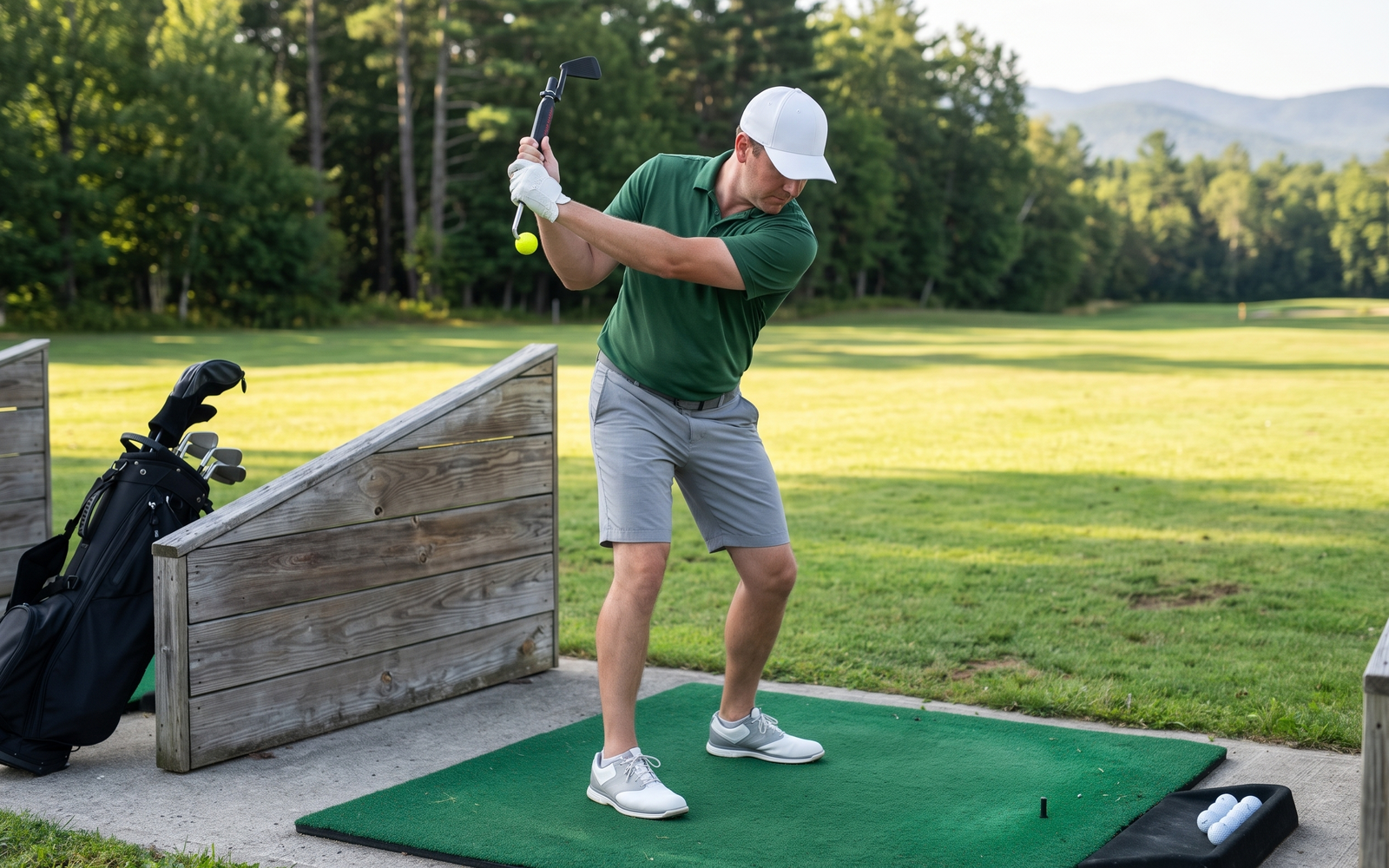
Final Scoring
| Category | Score | Max |
|---|---|---|
| Effectiveness | 25 | 30 |
| Value for Money | 19 | 25 |
| Build Quality & Durability | 19 | 20 |
| Ease of Use | 15 | 20 |
| Versatility | 3 | 5 |
| TOTAL | 81 | 100 |
At 81 out of 100, the Impact Snap beats live-ball clickers like the WhyGolf Wrist-X and edges out high-ticket electronic sensors on pure simplicity and durability. It isn’t magic on its own—you still have to turn your hips so you don’t groove a static wrist roll—but few indoor trainers ever built teach tour-style forward shaft lean more unmistakably.
The Bottom Line
Most training aids promise tour compression and deliver little more than a plastic distraction that breaks or gets forgotten in a month. The Impact Snap earned five Golf Digest Editors’ Choice awards and a decade of PGA coach loyalty because its dual feedback—an internal steel clack synced with a yellow ball tapping your trail forearm—gives amateurs a feel they almost never experience on their own.
If you decide to buy one, skip the $99.00 standalone version (assuming you swing right-handed) and order the $124.00 Combo directly from impactsnap.com with the Clubhead Attachment included. Put it beside your desk, take 30 to 50 body-driven dry swings a day while watching that matte-black grooved clubface stay square through impact, and bridge those reps straight into your next range iron session. Do the work honestly, and that floaty, scooped 7-iron finally turns into a crisp, compressed strike.
Frequently Asked Questions
What is the Impact Snap and how does it work?
How much does the Impact Snap cost (standalone vs. Combo)?
Do you really need the $25 Clubhead Attachment?
Is there a Left-Handed Impact Snap and Clubhead Attachment?
Can you hit real golf balls with the Impact Snap?
How big and heavy is the Impact Snap, and why does the website say 46 inches?
How loud is the Impact Snap click for offices or apartments?
Can you use the Impact Snap for chipping and pitching?
What is the Impact Snap warranty and return policy?
⛳ The 19th Hole: Final Verdict
The Impact Snap (81/100) is one of the clearest, toughest indoor mechanical trainers for curing the amateur scoop, cast, and chicken-wing through dual audio and forearm-contact feedback—provided right-handed buyers get the $124.00 Combo with the Clubhead Attachment and pair dry reps with real hip rotation.
Birdie Score: 81/100