Rypstick Speed Trainer: Worth It? (Honest Pros & Cons)
Birdie Score
Price
$199
One-Putt Summary
The Rypstick is a convenient, all-in-one speed trainer that reliably delivers 15+ yards of distance for golfers willing to follow a strict 8-week protocol and purchase a separate radar
Fairways (Pros)
- ✓ Proven 5-15 mph swing speed increases in 8 weeks
- ✓ All-in-one single club design fits easily in golf bag
- ✓ Excellent tool for quick pre-round muscle activation
- ✓ Free-ish app provides structured, easy-to-follow video protocols
- ✓ Auditory whistle feedback helps improve release timing
- ✓ No tools required for fast weight adjustments
Hazards (Cons)
- ✗ Speed radar essential for tracking but not included
- ✗ Temporary loss of accuracy during initial speed adaptation
- ✗ Requires strict 3x/week commitment for lasting results
- ✗ Speed gains fade quickly without ongoing weekly maintenance
- ✗ Advanced app training levels locked behind subscription
Best For
Mid-to-high handicap golfers (especially those 50+) willing to commit to a structured routine to regain lost distance
TL;DR
The Rypstick delivers legitimate, measurable speed gains (5-15 mph typical) if you commit to the protocol. It’s the most convenient speed trainer on the market—one compact stick versus three bulky clubs. But here’s what the ads don’t tell you: you need a $100-150 speed radar to track progress, gains disappear without maintenance, and your first month on-course will be chaotic as accuracy tanks while your body adapts. For committed golfers willing to invest $300-340 total and 45-60 minutes weekly, it works. For everyone else, it’s an expensive garage ornament.
What Is the Rypstick Speed Trainer?
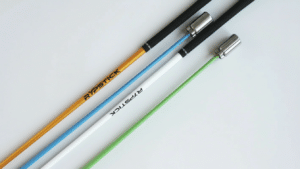
The Rypstick isn’t just another alignment stick with delusions of grandeur—it’s a legitimately engineered speed training system created by Dr. Luke Benoit, a PhD in motor learning and PGA Teacher of the Year. This 45-inch driver-length trainer uses variable weight protocols to reprogram your neuromuscular system for faster swings.
The Core Technology: Eight weight combinations via three removable 30-gram tungsten weights plus an optional 60-gram counterweight. You progress from light (underload training) to heavy (overload training), forcing your body to recruit fast-twitch muscle fibers it normally ignores. The system includes a free app with video-guided protocols, progress tracking, and structured training levels.
The Promise: Add 5-10 mph clubhead speed and 15-25 yards distance in 4-8 weeks with 15-20 minute sessions, three times per week. Over 100 PGA Tour players (Wyndham Clark, Dustin Johnson, Annika Sorenstam) use it—with zero paid endorsements, which adds legitimate credibility in an industry drowning in sponsored content.
At $199, it positions itself between budget-friendly SuperSpeed Golf ($150-200) and premium Stack System ($350+). But that’s just the entry price. The real investment is what comes next.
Build Quality & Durability: Built to Last (Mostly)
The Good News: The Rypstick is remarkably solid. Across hundreds of user reviews spanning forums, Reddit, and retailer sites, durability complaints are nearly non-existent. Users consistently describe it as “built to last” with no widespread reports of shaft breakage, weight chamber failure, or grip degradation.
The weight-adjustment mechanism is genuinely clever—a tool-free twist-dial system that lets you swap between light, medium, and heavy configurations in 5-10 seconds. This isn’t some flimsy plastic housing; it’s engineered to withstand thousands of maximum-effort swings.
Customer service gets universal praise. The one user who reported a spring issue received immediate replacement parts without hassle. Another user accidentally shipped their order to the wrong address while on vacation—customer service sent a second unit to their Palm Springs location for free and told them to mail the first one back when convenient.
The Hidden Durability Issue:
Multiple users report the 60-gram counterweight (which screws into the grip end) strips its threads after extended use. One 64-year-old documented it stripping twice before abandoning that feature entirely. The company hasn’t addressed this quality control issue publicly, and since counterweights cost extra to replace, it’s a frustrating flaw in an otherwise well-built product.
The Design That Actually Matters
At 45 inches, the Rypstick matches driver length—not the 41.5-inch “iron length” of The Stack System. Users consistently cite this as crucial for training speed in a motion that transfers directly to the club they actually want to hit farther. When you’re grooving neuromuscular patterns at 110+ mph, training with the wrong length stick is like practicing free throws with a volleyball.
Build Quality Score Breakdown
- ✓ Premium construction and materials (+9)
- ✓ Tool-free weight system works flawlessly (+6)
- ✗ Counterweight threading quality issues (-2)
- ✓ Single isolated spring replacement across 100+ reviews (+5)
Build Quality Score
Premium construction with minor counterweight flaw
18/20
Effectiveness: The Numbers Don’t Lie (But They Don’t Tell the Whole Truth)
Let’s start with what’s verifiable: the speed gains are real.
Independent testing from MyGolfSpy documented a 54-year-old gaining 11.6 mph in 30 days (93.6 → 105.2 mph average). Reddit users tracked 104 → 123 mph over 12 weeks. Golf Monthly forum members reported 2 mph gains in the first session. A podcast listener in his 50s went from 90 mph to 115 mph in 60 days, dropped his handicap from 16.7 to scratch, and shot a career-low 77.
These aren’t manufacturer testimonials—they’re launch monitor screenshots and radar data from actual users with no financial incentive to embellish.
The Senior Success Story
A 62-year-old user gained 7 mph (105 → 112 mph) and transformed his game: “My shortest drive is now 225 and I had two at 270 yards. I’m hitting wedges into greens I used to hit 7-irons into.” Another 70-year-old added 5 mph despite mobility limitations.
For aging golfers watching distance evaporate year after year, these results are genuinely life-changing.
But Here’s What the Success Stories Don’t Mention:
The Training Speed vs. Real Swing Gap:
Multiple users confirm practice speeds run 5-6 mph higher than actual driver swings with a ball. If you hit 118 mph during training, expect 112-113 mph on course. The transfer rate is roughly 70-85%, not 1:1.
The Chaos Phase is Real:
Nearly every user who gains 10+ mph reports a brutal transition period. Your swing timing, sequencing, and clubface awareness get completely disrupted. One Reddit user described going from “260 yards at 95 mph to 280 at 107 mph but with 3-5° wider dispersion.”
A MyGolfSpy tester was blunt: “There was a good modicum of chaos from the tee” during his first few rounds after training. Multiple users report temporarily quitting speed training to rebuild swing mechanics before resuming. Adding speed to a flawed swing doesn’t fix the flaw—it amplifies it exponentially.
The Equipment Obsolescence Problem:
This is the hidden cost nobody warns you about. One mid-handicapper gained significant speed, then discovered his professionally fitted “stiff” flex driver shaft was now too weak. The shaft deflected enough to leave the clubface open at impact, producing a consistent miss right. His irons launched too high with excessive spin. His wedges became unpredictable.
The diagnosis: a full bag re-fitting for stiffer, more expensive shafts. If you’ve recently invested in custom equipment, successful speed training might render it obsolete—a frustrating financial consequence of improvement.
What the Rypstick Actually Fixes (And Doesn’t):
This is NOT a swing correction device.
It doesn’t fix over-the-top, early extension, casting, or slicing. Zero users report it curing fundamental swing faults.
What it does train:
- ✓ Neuromuscular speed ceiling – Resets your body’s “speed governor”
- ✓ Fast-twitch muscle recruitment – Engages fibers you normally don’t activate
- ✓ Kinetic sequencing – When paired with coaching, improves power transfer
The indirect benefits users report: better release timing (the 60g counterweight helps), improved tempo from rhythm drills, enhanced weight shift. But these are byproducts, not the primary function.
The Brutal Truth from Users:
“If your swing has major flaws, fix those first with lessons. Speed training magnifies what you already do—good or bad.”
Effectiveness Score
Verified gains with transition challenges and hidden costs
23/30
- +12 Verified 5-15 mph gains across demographics
- +8 Real on-course distance improvements
- -3 Training speeds don’t fully transfer 1:1
- -2 Temporary but significant accuracy decline
- -2 Equipment obsolescence risk not disclosed
Ease of Use: Convenience is the Killer Feature
Here’s where the Rypstick absolutely destroys its competition.
The SuperSpeed Problem
SuperSpeed Golf requires three separate sticks (light, medium, heavy) that collectively feel like transporting a small fence. Users describe it as “bulky,” “nearly impossible to travel with,” and taking up half their trunk. Multiple Rypstick owners report giving away their SuperSpeed systems to friends specifically because of the portability nightmare.
The Rypstick Solution
One 45-inch stick. Eight weight combinations. Fits in your golf bag.
This isn’t just a nice-to-have—it’s the feature that makes consistent training possible. Because it lives in your bag, you actually use it.
The Weight-Change Brilliance
Twist the dial, slide out three tungsten weights, insert them in different combinations. No tools. Takes 5-10 seconds. Compare this to The Stack System’s more cumbersome process or SuperSpeed’s “grab the next stick” approach that requires carrying multiple clubs.
The App Experience
The free Rypstick app (iOS/Android) gets 8/10 ratings for user-friendliness. Embedded video demonstrations for every drill. Progress tracking calendar. Level 1 protocol completely free. The structured guidance removes all guesswork—you’re not figuring out drills yourself.
The Recent Betrayal:
The app recently shifted to a freemium model. Level 1 remains free, but Levels 2-4 now require a $49.99/year “Pro Plan” subscription. Users who bought the hardware feel “nickel-and-dimed”—they paid $199 for the stick, now they’re hit with ongoing annual fees for advanced protocols.
One frustrated forum user: “I already invested $200+ in the hardware. Now you’re paywalling the training levels that actually matter?”
The Pre-Round Warmup Discovery
This is the unexpected win that emerges organically from user discussions. Golfers report keeping the Rypstick in their bag permanently because a 5-minute parking lot warmup with it equals a full range session for loosening muscles and finding tempo. Users document 10 mph speed differences between cold-start tee shots versus post-warmup swings.
Ease of Use Score
Excellent hardware design; app subscription frustrates users
19/20
- +8 Single compact unit vs. 3-stick competitors
- +6 Tool-free 5-10 second weight changes
- +4 Intuitive app with video guidance
- -2 App subscription paywall frustrates users
- +3 Exceptional pre-round warmup utility
Value for Money: The Hidden Cost Revelation
Let’s do the math that Rypstick doesn’t advertise:
Advertised Price
$199
for the trainer
Speed Radar
$100-150
(functionally mandatory)
Actual Total
$349-399
first-year investment
Why the Radar is Non-Negotiable
Every serious user across forums, Reddit, and review sites says the same thing: without a speed radar, you’re flying blind. The instant quantitative feedback serves three critical functions:
- 1. Motivation – Watching the numbers climb keeps you engaged
- 2. Accountability – Forces maximum effort on every swing (easy to coast otherwise)
- 3. Education – Teaches you what actually creates speed versus what just feels fast
One user was blunt: “You can train without a radar, but you won’t know if you’re actually getting faster. It’s like trying to lose weight without a scale.”
The Maintenance Cost Nobody Mentions
This isn’t a “train once and forget” solution. Users who stop training for 2+ months lose 5-10 mph of gains. One long-term owner documented dropping from 130 mph to 115 mph after a summer off, though he regained to 125 mph within 10 days of restarting.
The Rypstick is an ongoing fitness tool, not a one-time fix. Factor in the time commitment: minimum 45-60 minutes weekly forever to maintain gains. For golfers with tight schedules, this “hidden cost” of perpetual training might be the real dealbreaker.
Value for Money Score
Justified for committed users; expensive vs. alternatives
15/25
- +8 Delivers on core speed promise
- +5 Better value than Stack, more features than SuperSpeed
- -5 Hidden radar cost creates $350 real investment
- -3 App subscription paywall adds ongoing fees
- +2 No true cheaper functional alternatives
- -2 Maintenance requirements not disclosed upfront
Versatility: One Trick, Done Exceptionally Well
Unlike multi-purpose training aids that claim to fix everything and excel at nothing, the Rypstick has a laser focus: make you swing faster. That’s it. And it’s brilliant precisely because it doesn’t pretend to be something it’s not.
What It Trains: Progressive Overload/Underload Protocols
- • Light weights (underload): Train neuromuscular system for speed
- • Heavy weights (overload): Build swing-specific strength
- • Standard weights: Reinforce patterns at normal resistance
What It Doesn’t Train (And Shouldn’t):
The Rypstick provides:
- ❌ Zero swing path feedback
- ❌ No clubface awareness training
- ❌ No impact quality diagnosis
- ❌ No fix for over-the-top, early extension, or casting
This isn’t a limitation—it’s appropriate scope. Speed training is a standalone discipline. Expecting it to also fix swing faults is like expecting your gym membership to teach you proper deadlift form.
Versatility Score
Does one thing exceptionally well, appropriate scope
5/5
Who Should (and Shouldn’t) Buy This
STRONG BUY Recommendation
The “Committed Improver” (45-70 years old):
If you’re watching distance evaporate with age and you’re willing to invest 45-60 minutes weekly for 8-12 weeks, the Rypstick delivers transformative results. The 62-year-old gaining 7 mph and hitting 270-yard drives, the 70-year-old adding 5 mph despite mobility issues—these aren’t outliers. Senior success stories dominate user testimonials.
Mid-handicappers with sound fundamentals (10-20 range):
You have repeatable mechanics but lack power. Five to ten mph of added speed translates to 15-25 yards, which means hitting 8-irons instead of 6-irons into greens. That’s the difference between bogeys and pars.
Data-driven golfers who already own launch monitors:
If you have a speed radar or simulator with swing metrics, the Rypstick becomes a precision training tool rather than a blind experiment. You can track gains session-by-session and optimize your protocol.
Players willing to navigate the “chaos phase”:
You understand that temporarily worse accuracy is the price of long-term distance gains. You’re prepared to invest range time recalibrating your swing to new speeds.
PROCEED WITH CAUTION
-
⚠
Budget-conscious golfers balking at the real $350 cost: If the $199 advertised price is already stretching your equipment budget, the revelation that you need a $100-150 radar for effective training will sting. SuperSpeed at $200 total might be a better fit.
-
⚠
Golfers with recent back, shoulder, or wrist injuries: The protocol demands maximum-effort swings that stress your body beyond normal golf. Multiple users warn about hip, oblique, and back soreness.
-
⚠
Players in competitive season prioritizing accuracy: The 2-4 week transition period where dispersion widens isn’t ideal when you’re trying to qualify or compete. Speed training is off-season work, not in-season maintenance.
AVOID IF
-
✗
You have major unaddressed swing flaws: The user consensus is brutal and unanimous: “If your swing has severe flaws, speed training magnifies them. Fix the mechanics first.”
-
✗
You’re a casual golfer unwilling to commit 3x/week for months: Speed gains require structured, consistent effort. If you practice sporadically or prefer unstructured range sessions, this becomes an expensive garage ornament.
-
✗
You’re already swinging 110+ mph: Advanced long drivers approaching biomechanical speed ceilings see diminishing returns. The Stack System’s 30+ weight combinations and advanced analytics become more valuable at elite speeds.
-
✗
You expect instant on-course results: Speed gains develop over 4-8 weeks. On-course transfer takes another 2-4 weeks of accuracy recalibration. If you want 20 yards overnight, you’ll be disappointed and frustrated.
The Bottom Line: It Works, But Not How You Think
The Rypstick delivers on its core promise: legitimate, measurable, lasting speed gains. The manufacturer’s 5-15 mph claim is validated by independent user data across multiple platforms with launch monitor verification.
But here’s the reality they don’t advertise:
You’re not buying a $199 training aid. You’re investing $350-400 total (radar + subscription), committing to 45-60 minutes weekly forever (gains are perishable), accepting 2-4 weeks of chaotic accuracy (your first month on-course will be rough), and potentially facing equipment obsolescence (your custom-fit shafts may need replacing).
The senior golfer truth:
If you’re 50-70 years old watching distance disappear year after year, and you can dedicate the time and money, the Rypstick is genuinely life-changing. The testimonials aren’t exaggerated—62-year-olds gaining 7 mph, 70-year-olds adding 5 mph, golfers hitting wedges into greens they used to reach with 7-irons.
The competitive golfer truth:
If you’re a serious mid-handicapper (10-20 range) with sound mechanics who’s plateaued in distance, and you’re prepared for the chaos phase, five to ten mph translates to meaningful scoring improvement.
The casual golfer truth:
If you play sporadically, practice inconsistently, or prioritize simplicity over optimization, the Rypstick is overkill. SuperSpeed Golf at $200 total with no subscription fees and a simpler protocol will deliver 80% of the results with 50% of the hassle.
The Ultimate Test
The 40-60 day money-back guarantee is your safety net. Order it, commit to the Level 1 protocol for 6-8 weeks, track your radar data obsessively, and evaluate whether the gains justify the investment. If you gain 8-10 mph and love the results, keep it and upgrade to Pro Plan. If you gain 3 mph and find the commitment frustrating, return it for a refund.
The Rypstick isn’t for everyone. But for the right golfer—committed, patient, data-driven, and willing to invest in long-term athleticism—it’s the most effective convenience-optimized speed trainer on the market.
FAQ: Your Rypstick Questions Answered
Do I really need to buy a separate speed radar?
How long before I see real on-course distance gains?
Will this fix my slice/over-the-top swing?
What if I stop training for a few months?
I’m 65 years old—am I too old for this?
Can I use this indoors?
My custom-fit driver cost $600—will I need to replace it?
How does it compare to SuperSpeed Golf?
Is the $50/year app subscription worth it?
⛳ The 19th Hole: Final Verdict
The Rypstick is a convenient, all-in-one speed trainer that reliably delivers 15+ yards of distance for golfers willing to follow a strict 8-week protocol and purchase a separate radar
Birdie Score: 79/100