whyGolf Wrist-X: Is One Click Worth $100?

Birdie Score
Price
$100
One-Putt Summary
A dead-simple wrist trainer that delivers honest, real-time feedback mid-swing that's effective for mid-handicappers, but you'll pay a premium for plastic
Fairways (Pros)
- ✓ Real-time audible click — hear it mid-swing, not after
- ✓ Adjustable 0°–70° threshold fits any grip or swing style
- ✓ Works on both lead and trail wrist — rare among competitors
- ✓ Legitimately useful for chipping and putting, not just full swing
- ✓ 99-day money-back guarantee + lifetime warranty
Hazards (Cons)
- ✗ No data, no metrics — just pass/fail; data lovers will hate this
- ✗ Plastic build at ~$100 feels premium-priced for the materials
- ✗ Doesn't diagnose your fault — you need to know what you're fixing
- ✗ Return shipping is on you if it doesn't work out
- ✗ Too new for long-term durability verdict (launched Jan 2026)
Best For
Mid-handicap golfers (10–22 HCP) who flip, cast, or cup the lead wrist and want real-time, tech-free feedback without paying for a HackMotion
🏌️ Key Takeaways
The whyGolf Wrist-X is one of the simplest, most immediately useful wrist trainers on the market. Strap it on, set your hinge angle, and the audible click tells you — in real time, mid-swing — whether you nailed it. No app, no Bluetooth, no PhD required. It’s not cheap for what is ultimately a plastic device, and it won’t give you data to geek out on. But for mid-handicappers who flip, cast, or cup the lead wrist, this little clicker may be the most honest feedback partner you’ve ever had.
Let’s Be Honest About Golf Training Aids
Most golf training aids follow the same script: bold claims, slick packaging, two practice sessions, then a new life at the back of the closet next to that foam roller you were definitely going to use every morning. So when a new wrist trainer shows up at the 2026 PGA Show and starts generating genuine buzz, that’s worth paying attention to.
The whyGolf Wrist-X is not a revolutionary piece of technology. It doesn’t sync to your phone, graph your swing arc, or send haptic alerts to your Apple Watch. What it does — and does remarkably well — is make a satisfying click when your wrist hinge hits the angle you’re training for. That’s it. And for a huge chunk of the amateur golfing population, that single, simple, mechanical cue might be exactly what’s been missing from their practice routine.
This review digs into what the Wrist-X actually does, how well it holds up, who it’s genuinely built for, and whether the $100 price tag is justified. We’ll pull no punches. If something is great, we’ll say so. If something feels like a compromise, you’ll hear about that too.
What Is the whyGolf Wrist-X?
The whyGolf Wrist-X is a mechanical wrist training device worn on either the lead or trail wrist during the golf swing. Its defining feature is an adjustable click mechanism that activates when your wrist reaches a preset hinge angle — anywhere from 0° to 70°. Think of it as a threshold alarm: you don’t get a sound when you’re still warming up, but the moment you hit (or exceed) the target position, click.
whyGolf — the brand behind popular training aids like the Pressure Plate and WhyGolf Alignment Discs — positions the Wrist-X as a tool for fixing the most common ball-striking killers in the amateur game: the cupped lead wrist, early casting, and the flip at impact.
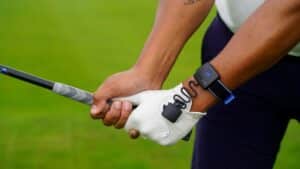
The device straps to your wrist via a two-strap system and can be worn directly on skin or over a golf glove. It comes with a nylon travel bag (bag-friendly, no excuses) and a QR code linking to tutorial videos that walk you through setup and the specific drills you should be doing. Launched in January 2026, it’s still new enough that the long-term community verdict is still forming — but early signals are encouraging.

- The cupped lead wrist at the top of the backswing (the #1 cause of the open clubface and slice)
- Early release / casting the club from the top
- Flipping the wrists through impact (the death move for any kind of consistent compression)
- Wrist breakdown in the chipping and putting stroke
The Biomechanics Behind the Click
Here’s the thing that makes the Wrist-X’s design clever: it’s not just feedback, it’s the right kind of feedback at the right time.
Instructional theory distinguishes between two types of feedback: Knowledge of Results (KR) — you found out what happened — and Knowledge of Performance (KP) — you know what your body did to cause it. The Wrist-X delivers KR in real time, during the motion. When you hear the click at the top of your backswing, you don’t need to watch a replay or decode a graph. You know, right now, that your wrist hinge reached the target. When you don’t hear it, you know you came up short. No interpretation required.
Compare that to a digital sensor that measures your wrist flexion/extension in degrees and feeds it back to an app after the shot. Useful data, for sure — but you’ve already moved on mentally to the next swing. The click keeps you in the loop in the moment, which turns out to matter a lot for motor learning.
⚡ The Reality Check
Approximately 85% or more of amateur golfers struggle with a lead wrist that cups at the top, opening the clubface and creating the compensatory over-the-top move that produces slices and pulls. The Wrist-X is specifically targeting this very common fault. It’s not solving an esoteric problem — it’s going after the one thing that kills most recreational golfers’ ball striking.
Setting the Wrist-X to around 54 degrees — roughly the tour average for wrist hinge — gives you what one reviewer aptly called an ‘objective Standard of Truth’ in a sport where feel is notoriously unreliable. Many users report that simply trying to make the device click at the right moment automatically improves several secondary swing faults: their backswing gets longer, their shoulder turn improves, and the downswing transition becomes smoother — because the body has to move correctly to achieve the wrist angle.
Effectiveness: Does It Actually Work?
Let’s talk results. Early adopters and reviewers who have spent three or more weeks with the Wrist-X are reporting real, measurable improvements. The anecdotes coming from actual users — not influencers with ‘gifted product’ disclosures — are compelling.
The Evidence
Customer Reports: Fixing a Chronic Slice in a Single Session
A customer on whyGolf’s own product page described setting the device to 55 degrees on the trail wrist and fixing a chronic slice in 5 to 10 minutes. Specifically: once the Wrist-X forced a flatter lead wrist position, the clubface arrived squarer at the top, eliminating the need to come over the top to compensate. Goodbye slice. That kind of report should always be read with some healthy skepticism — but the biomechanical logic tracks perfectly.
A Reddit user in r/whygolf put it this way when comparing the Wrist-X to the HackMotion: the click happens while you’re swinging, not in a post-session app review. That distinction — hearing feedback in the motion rather than analyzing it afterward — is the biggest practical advantage this device has over more expensive digital alternatives.
A golfer who was skeptical going in reported that sustained use over several weeks revealed faults she’d been completely blind to — specifically, she wasn’t setting the club sufficiently at the top, then compensating with an early flip. The Wrist-X acted as a constant monitor during practice sessions, eventually helping her transition from mechanical thought to muscle memory.
What It Fixes — And What It Doesn’t
The Wrist-X monitors wrist extension and flexion — essentially, whether you’re cupping or bowing your wrist. That’s one axis of movement, and it’s the most important one for the majority of recreational golfers. But it does not track radial or ulnar deviation. If your swing issues live somewhere else, the click won’t help you find them.
It also won’t diagnose your problem for you. You need to know going in that your issue is wrist-related — cupping, casting, flipping. If your main problem is a steep swing plane, a faulty weight shift, or grip pressure, the Wrist-X is not your tool. whyGolf makes separate products for those issues.
- Cupped lead wrist at the top of backswing
- Early casting and loss of lag
- Flipping through impact
- Wrist breakdown in chipping and putting
- Grip issues: Zero feedback on hand position
- Weight transfer problems
- Swing plane faults
- Side-to-side wrist deviation (radial/ulnar)
Effectiveness Score
Strong for its intended purpose; single-axis monitoring limits scope
Build Quality & Durability: The Honest Take
This is where we have to be straight with you, because it’s the section most likely to influence your purchase decision.
The whyGolf Wrist-X is made primarily of plastic. At approximately $100, you are not getting a device that feels like a precision engineering instrument. The mechanism is injection-molded, the straps are functional but not luxurious, and the overall aesthetic is closer to ‘sports medicine store’ than ‘premium golf equipment.’
That said — and this matters — reviewers who have actually used the device consistently report that it doesn’t feel cheap or gimmicky once it’s on. The click mechanism feels solid and purposeful. The strap system is secure without being uncomfortable. The Wicked Smart Golf reviewer, who has tested whyGolf products since 2022, specifically noted that the Wrist-X ‘fits naturally into practice without overcomplicating the swing’ and doesn’t have the flimsy feel of budget training aids.
What’s in the Box
- The Wrist-X device with adjustable click wheel (0–70° range)
- Two-strap attachment system (fits over glove or bare skin)
- Nylon travel/carry bag — genuinely bag-friendly
- QR code card linking to tutorial videos
The Warranty Situation
whyGolf backs the Wrist-X with a lifetime warranty on the device and a 99-day money-back guarantee. That’s significantly longer than the industry standard 30-day window and signals real manufacturer confidence in the product. In a category full of overnight gimmicks, that kind of commitment matters. The founder is reportedly known to personally respond to customer support inquiries, which adds another layer of brand trust.
⚠️ Long-Term Durability Caveat
The Wrist-X launched in January 2026. There simply isn’t enough long-term field data yet to declare it built to last. The few users who’ve reported on durability say it’s held up without issue — but two months is not a stress test. The lifetime warranty mitigates this uncertainty significantly, but it’s worth flagging. One minor gripe worth noting: if you want to return it, the return shipping is on you.
Build Quality & Durability Score
Functional and solid; plastic construction at $100 makes some buyers wince. Lifetime warranty is a genuine differentiator.
Ease of Use: Refreshingly Simple
This might be the Wrist-X’s single strongest category, and it deserves real credit. In a world of Bluetooth pairing, app calibration, firmware updates, and battery management, the Wrist-X is aggressively, almost defiantly simple.
Strap it on. Turn the dial to your target angle. Swing. If you hear a click, you did it. If you don’t, you didn’t. That’s the entire setup process.
There’s no app to download. No sensor to calibrate before every session. No risk of showing up at the range and realizing your device needs to charge. The QR code tutorial videos eliminate most of the initial setup confusion, and users almost universally describe the strap system as ‘intuitive’ and ‘super easy.’ Even first-time users report understanding how the device works within minutes.

Strap-on-and-go design removes every technical friction point that plagues more sophisticated training aids. From unboxing to first swing in under two minutes.
The flip side of simplicity: if you want the device to tell you what’s wrong, you’ll be disappointed. You need to arrive knowing which fault you’re correcting and what angle to target.
Ease of Use Score
Near-perfect. Lost two points because beginners without coaching knowledge may not know what threshold to train at.
Value for Money: The Uncomfortable Truth
This is the category where honest reviewers have to acknowledge a real tension, and we’re not going to sugarcoat it.
At approximately $100, the whyGolf Wrist-X is a plastic device with a click mechanism. You can buy a generic wrist brace or a ‘hanger’-style training aid on Amazon for $15 to $25. Some critics — and there are legitimate ones — argue the Wrist-X is charging a significant premium for what is fundamentally simple technology.
Here’s the counter-argument, and it’s worth hearing: the Wrist-X’s value is not in the materials. It’s in the adjustability, the binary pass/fail feedback, and the precision of the click mechanism at a specific angle. Generic wrist trainers tend to be restrictive (they prevent movement rather than measure it) and non-adjustable (one fixed position for everyone). The Wrist-X does something meaningfully different from a $15 alternative, and most users who have tried both say so.
The Comparison That Actually Matters
The Honest Take on Value
The real comparison isn’t Wrist-X vs. cheap Amazon brace. It’s Wrist-X vs. HackMotion. If you want rich data, multi-axis tracking, and progress graphs, HackMotion is probably worth the extra investment. But if you’re a mid-handicapper who practices 30–60 minutes twice a week and just wants to feel what a proper wrist set is like, paying $200 more for data you might not fully know how to use is arguably poor value.
The 99-day money-back guarantee is the real value insurance here. Three months of actual play and practice — moving through the inevitable dip that accompanies any swing change — before you have to commit to keeping it. That’s the kind of confidence in a product that separates the training aids that actually work from the ones that don’t.
Value for Money Score
Justified against the HackMotion alternative; the 99-day guarantee does meaningful work reducing purchase risk.
Versatility: The Surprise Package
Nobody puts ‘putting aid’ in the headline when marketing a wrist trainer. But one of the most consistent themes across Wrist-X user feedback is how useful it turns out to be on the green and around the chipping area.
Set the threshold to near zero degrees and you’ve essentially locked your wrists into a stable, quiet position — perfect for training a putter stroke that doesn’t break down through impact. Coaches have been demonstrating this use case on YouTube, and golfers are reporting real improvements in chipping consistency by keeping the hands ‘dead’ through impact.
YouTuber Scott Hogan Golf, who described his short game as having deteriorated to the point where he didn’t want to play golf, used the Wrist-X to reinforce proper wrist structure in his chipping and called it a game changer for his short game recovery.
That kind of versatility — full swing, chipping, putting, indoor practice, outdoor range, fits in any golf bag — is genuinely unusual for a training aid in this price range and dramatically increases the product’s usefulness-per-dollar calculation.
- Full swing wrist hinge training (primary use)
- Chipping and pitching wrist stability work
- Putting stroke breakdown prevention
- Indoor/home practice during off-season
- Pre-round warmup to groove wrist feel
- Post-lesson reinforcement — lead wrist or trail wrist
Versatility Score
A perfect score. Full swing, chipping, putting, lead wrist, trail wrist, indoor, outdoor — the Wrist-X earns its keep across the entire game.
How It Stacks Up: Analog vs. Digital
The training aid market for wrist feedback basically splits into two camps: analog devices like the Wrist-X, and digital sensors like HackMotion. They solve the same problem through completely different philosophies.
- Tracks flexion, extension, and rotation in real time
- App-based with graphs, session history, and benchmark data
- Priced at $299–$399 — more than 3x the Wrist-X
- Requires calibration, charging, Bluetooth before sessions
- Best for: data-driven players, single-digit handicappers, coaches
- Binary feedback: click or no click
- Zero tech, zero friction — strap on and swing
- $100, adjustable 0–70°, works on both wrists
- Best for: mid-handicappers, feel-based learners, range warmup
As one Reddit user summarized: ‘I’m not claiming Wrist-X is objectively better than HackMotion; it’s simply more practical.’ That’s probably the most accurate single-sentence verdict on this product. If you want a coaching tool that gives you a complete wrist profile, buy the HackMotion. If you want something you can clip on and use without thinking about it, the Wrist-X wins.
Fairways & Hazards: The Honest Pros and Cons
Fairways (Strengths)
- Immediate in-motion feedback — click happens during the swing, not after
- Zero tech friction — no app, no charging, no calibration
- Genuine versatility — full swing, chip, putt, lead or trail wrist
- Lifetime warranty — rare and meaningful in this category
- 99-day trial — longest risk-free window in training aids
Hazards (Limitations)
- Plastic build at $100 — materials don’t match the price point
- Single-axis monitoring — no radial/ulnar deviation tracking
- No diagnosis — you must already understand your fault
- Return shipping on buyer — can add $10–$15 to return cost
- Unproven long-term durability — product is only a few months old
The Bottom Line: Who Should Buy the whyGolf Wrist-X?
- A mid-handicapper (10–22) who is flipping, casting, or cupping the lead wrist
- A feel-based learner who gets overwhelmed by data, apps, and post-swing analysis
- Someone who practices at home, at a simulator, or indoors during the off-season
- A golfer who has been told by an instructor that their wrist position at the top needs work
- Looking to fix a chronic slice caused by an open clubface at the top of the swing
- Shopping for a wrist training alternative to HackMotion that doesn’t require a $300+ investment
- A single-digit handicapper who needs degree-by-degree data to make marginal gains
- A complete beginner with no coaching — you need to know your fault first
- Someone whose main issues are swing path, weight shift, or alignment (not wrists)
- A golfer looking for grip correction — the Tour Striker FlexClick addresses grip AND wrist at a similar price
- Extremely value-conscious and perfectly happy with a $15 generic hanger from Amazon
Final Scoring
| Category | Score | Max |
|---|---|---|
| Effectiveness | 24 | 30 |
| Build Quality & Durability | 14 | 20 |
| Ease of Use | 18 | 20 |
| Value for Money | 18 | 25 |
| Versatility | 5 | 5 |
| OVERALL SCORE | 79 | 100 |
Frequently Asked Questions
What handicap is the whyGolf Wrist-X best for?
The sweet spot is mid-handicap golfers in the 10–22 range who struggle with wrist-related faults like cupping, casting, or flipping. Lower handicappers may find the single-axis binary feedback too limiting. Higher handicappers without any instruction may not know what threshold to set or which fault to address first.
How does the adjustable click mechanism work?
The Wrist-X features a dial you rotate to set a hinge angle between 0° and 70°. When your wrist reaches or exceeds that angle during the swing, the mechanism produces an audible click. Lower settings (10–20°) are useful for putting or chipping; higher settings (50–60°) target full backswing hinge positions. Tour average is approximately 54 degrees.
Can the whyGolf Wrist-X be used for putting?
Yes — and this is one of the Wrist-X’s genuine surprises. Set the dial to a very low threshold and it acts as a wrist-stability monitor during the putting stroke, flagging any breakdown through impact. Multiple coaches have demonstrated this application on YouTube, and golfers report meaningful improvements in putting consistency.
Is the whyGolf Wrist-X better than the HackMotion?
It depends entirely on what you need. HackMotion provides rich multi-axis data, progress tracking, and precise measurements — ideal for data-driven players or coaching environments. The Wrist-X is simpler, cheaper, and more immediately practical for the average golfer. It’s better for training feel; HackMotion is better for diagnosis. A Reddit user put it best: ‘It’s simply more practical’ for the average player.
What wrist fault does the Wrist-X fix?
It primarily addresses wrist extension faults — specifically the cupped lead wrist that opens the clubface at the top of the backswing and leads to slices and compensatory over-the-top moves. It also helps identify early casting (losing lag too soon in the downswing) and flipping through impact. It does not track radial or ulnar deviation (side-to-side wrist movement).
Can beginners use the Wrist-X without instruction?
With caution. The device is easy to use physically, but you need to understand what fault you’re correcting and what angle you should be targeting. Without that baseline knowledge, you risk setting the wrong threshold and reinforcing incorrect mechanics. A few lessons with a PGA professional first would make this tool significantly more effective.
What’s the return policy on the whyGolf Wrist-X?
whyGolf offers a 99-day money-back guarantee on the Wrist-X — one of the longest trial periods in the training aid category. However, return shipping costs are the customer’s responsibility. The device also includes a lifetime warranty on the click mechanism.
Can you wear the Wrist-X on the trail (right) wrist for right-handed golfers?
Yes. The Wrist-X can be worn on either the lead or trail wrist, giving it flexibility that most competitors lack. Training on the trail wrist targets extension faults that affect how the clubface is presented at the top of the backswing.
How long before I see improvement with the Wrist-X?
Early users report awareness changes in the first session, particularly recognizing faults they didn’t know they had. Meaningful ball-striking improvements typically emerge after two to four weeks of consistent use. As with any training aid, the Wrist-X works best when paired with deliberate practice and an understanding of the specific change you’re making.
Is the Wrist-X worth $100 compared to cheaper alternatives?
If your comparison is to a $15 Amazon wrist brace: yes, the adjustability and binary click mechanism offer meaningfully different feedback. If your comparison is to a DIY hanger-style aid: honest answer — you can simulate some of the same wrist-position awareness for less. The Wrist-X’s edge is precision, convenience, and the 99-day risk-free trial. The lifetime warranty reduces the long-term risk considerably.
⛳ The 19th Hole: Final Verdict
A dead-simple wrist trainer that delivers honest, real-time feedback mid-swing that's effective for mid-handicappers, but you'll pay a premium for plastic
Birdie Score: 79/100