EyeLine Golf Speed Trap 2.0 Review – Is the Slice Fix Worth $100?
Birdie Score
Price
$120
One-Putt Summary
The EyeLine Golf Speed Trap 2.0 is one of the most brutally honest swing path trainers on the market — it genuinely works, but it will humble you before it helps you.
Fairways (Pros)
- ✓ Instant, unmistakable swing path feedback — zero ambiguity
- ✓ Proven slice and hook correction backed by real user results
- ✓ 'Unbreakable' polycarbonate base survives 1,000+ sessions
- ✓ Works with every club — driver to wedge — on mats and grass
Hazards (Cons)
- ✗ $120 feels steep vs. $15 DIY alternatives
- ✗ Tells you what went wrong — never why
- ✗ Steep learning curve; many abandon it before progress clicks
- ✗ No feedback for thin or topped shots
Best For
Mid-to-high handicappers (15–36+) battling a chronic slice or hook rooted in swing path — especially visual learners willing to commit to deliberate practice and pair the device with at least occasional instruction or video analysis.
⛳ ONE-PUTT SUMMARY: The EyeLine Golf Speed Trap 2.0 is the most brutally honest swing path trainer on the market — it genuinely works, but it will humble you before it helps you. Score: 76/100 │ Verdict: Recommended for committed mid-to-high handicappers who pair it with instruction or video analysis.
⚡ Key Takeaways
- ✓ Delivers instant, unmistakable feedback on swing path and ground contact — no ambiguity, no cheating the device
- ✓ Genuinely fixes slices: one Amazon reviewer broke 85 for the first time after three one-hour sessions
- ✓ ‘Unbreakable’ polycarbonate base rated for 1,000+ sessions — durability is a genuine strength
- ✓ The 2.0 tethers solved the biggest complaint from version 1.0 (flying rods across the range)
- ⚠ Tells you WHAT went wrong — never WHY. Pair it with a lesson or video, or you risk building compensations
- ⚠ $99–$119 feels steep versus a $15 DIY foam-noodle alternative — your call on whether results justify cost
- ⚠ Steep learning curve — golfers who aren’t willing to embrace frustration will abandon this in weeks
| Category | Score | Max | Rating Summary |
|---|---|---|---|
| Effectiveness | 26 | 30 | Excellent path trainer; no root-cause diagnosis |
| Build Quality & Durability | 18 | 20 | ‘Unbreakable’ base; minor rod concerns |
| Ease of Use | 13 | 20 | Steep learning curve; intimidating at setup |
| Value for Money | 15 | 25 | Pricey vs. materials; justified by results |
| Versatility | 4 | 5 | Driver to wedge; mats and grass |
| OVERALL SCORE | 76 | 100 | Strong — best for committed path-issue golfers |
What Is the EyeLine Golf Speed Trap 2.0?
Let’s be honest — the training aid market is littered with gimmicks. Flashy gadgets that promise to cure your slice in one bucket of balls, only to collect dust in your garage three months later. The EyeLine Golf Speed Trap is not that product. It’s older, less glamorous, and it will absolutely ruin your range session — at first. That’s kind of the point.
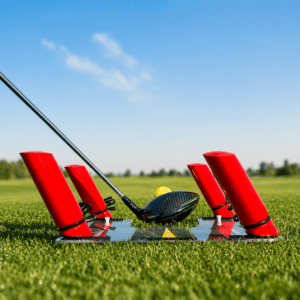
The Speed Trap is a polycarbonate base plate roughly the size of a large hardcover book, into which you insert soft foam rods to create a physical corridor — or ‘gates’ — that your clubhead must travel through at impact. Hit through the channel cleanly and nothing happens. Swing over-the-top, too inside-out, or clip the plate with a fat strike and the device lets you know. Immediately. Loudly. Unmistakably.
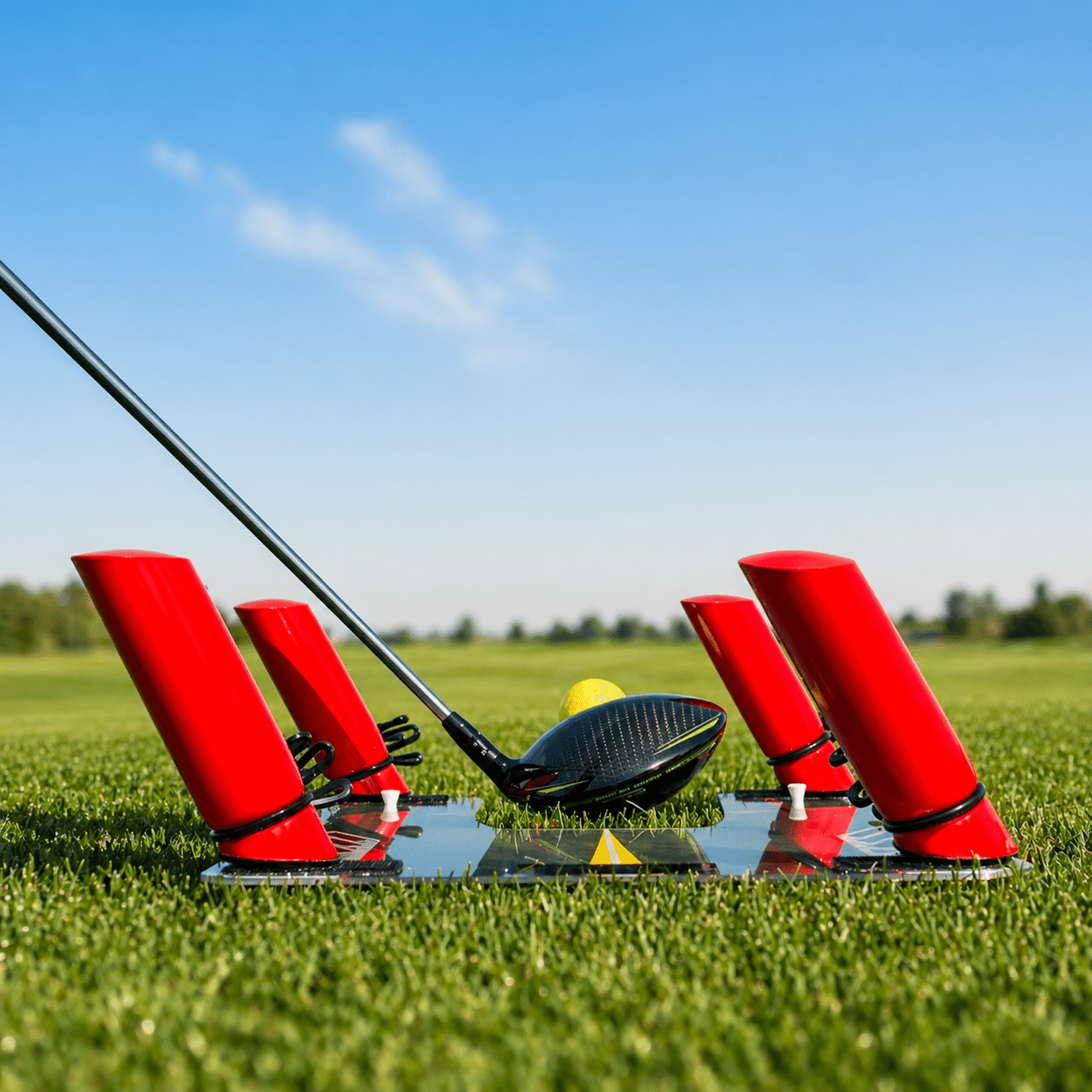
EyeLine Golf, the Minnesota-based training aid company behind the product, pitches it as a swing path corrector and low-point trainer that works across the entire bag — driver, irons, wedges, even chipping and pitching. The 2.0 version (the current model) improved on the original with tethered foam rods, a wider base to accommodate driver practice, stronger polycarbonate construction, and a carry bag. There’s also a newer 4S compact model designed to fit inside a golf bag, but this review focuses primarily on the 2.0.
At $99–$124.95 (occasionally found on sale around $64), it’s not cheap for what is, at its core, a plastic plate and some foam sticks. But as we’ll get into, the price-versus-results question is one of the most interesting tensions in this entire product’s story — and real users have very strong opinions about it.
What EyeLine Claims It Does
Claimed Training Benefits
- ✓Swing path — Foam rod gates force in-to-out or straight-path swings, correcting the out-to-in path that causes slices
- ✓Low point and ground contact — The base plate punishes fat shots, training a forward, ball-first strike
- ✓Shot shaping — Adjustable rod configuration promotes draws, fades, or straight shots
- ✓Short game — Ball position markers on the base guide chip, pitch, and full-swing setup
The Core Premise
These aren’t marketing fantasies — the feedback mechanism is real, and users consistently confirm it works. The more nuanced question is whether it works for you, in your practice environment, at your skill level. That’s where things get complicated.
Build Quality & Durability: Rock-Solid Where It Counts
The good news on build quality is simple: the base doesn’t break. Multiple users across Amazon, GolfWRX, and editorial reviews confirm the polycarbonate base survives repeated club strikes — including full iron shots off the plate — without cracking or deforming. One reviewer described watching their eight iron smack the baseplate and walked away impressed it stayed intact. That’s not an accident; polycarbonate is the same material used in bulletproof glass, and EyeLine’s decision to use it here pays long-term dividends.
The foam rods are soft, lightweight, and won’t damage your clubs — an important practical consideration when you’re intentionally swinging into them. The tethers introduced in the 2.0 are a functional upgrade over the original’s loose rods, which would fly 10–20 yards down the range on mishits (a genuine embarrassment at a busy range, per multiple user reports).
“You can hit the base as hard as you want and it won’t break. The actual design is very clever and well made. The parts and pieces seemed high quality and have stood up well to use.”
— Verified User, obsessed.golf
The Durability Reality Check
✓ What holds up:
The polycarbonate base is effectively indestructible. No reported cases of cracking, warping, or structural failure even after thousands of aggressive swings. The 2.0’s tethered foam rods prevent the “flying rod across the range” problem that plagued version 1.0.
✗ Minor caveats:
A small number of users reported decal scratching and flaking on older units, and the plastic ties securing rods can be stiff and fiddly to slot on initially. Foam rod holders have occasionally broken with very heavy use, though EyeLine includes extras and replacement rods are available.
Build Quality Score
An exceptionally durable training aid for its category
Effectiveness: Does It Actually Fix Your Swing?
This is where the Speed Trap earns its reputation. The core feedback loop — swing through the gates cleanly or get immediate, unavoidable physical and audible feedback — is as honest as it gets in the training aid world. You cannot cheat the device. You cannot talk yourself into believing your path is fine when the rod is bouncing off the mat.
What They Fix (With Receipts)
Over-the-Top Slices: This is the Speed Trap’s specialty.
Across GolfWRX, MyGolfSpy, Amazon, Golf Monthly, and Practical Golf, the single most cited benefit is instant, unmistakable swing path feedback. And the results back it up consistently across hundreds of user reports.
“After about an hour of hitting balls into a net using the Speed Trap 2.0, I gained a really good understanding of how I needed the club to move to produce a smooth draw. I then went onto the course and the results were exactly as I had hoped — I had brought back a smooth baby draw and had eradicated the push-slice out of the heel.”
— Sam De’Ath, former EuroPro Tour player & Golf Monthly Equipment Expert
“I bought this and used it for about an hour three days in a row leading up to a round, and it pretty much fixed my slice. I broke 85 for the first time that round.”
— Amazon Verified Buyer
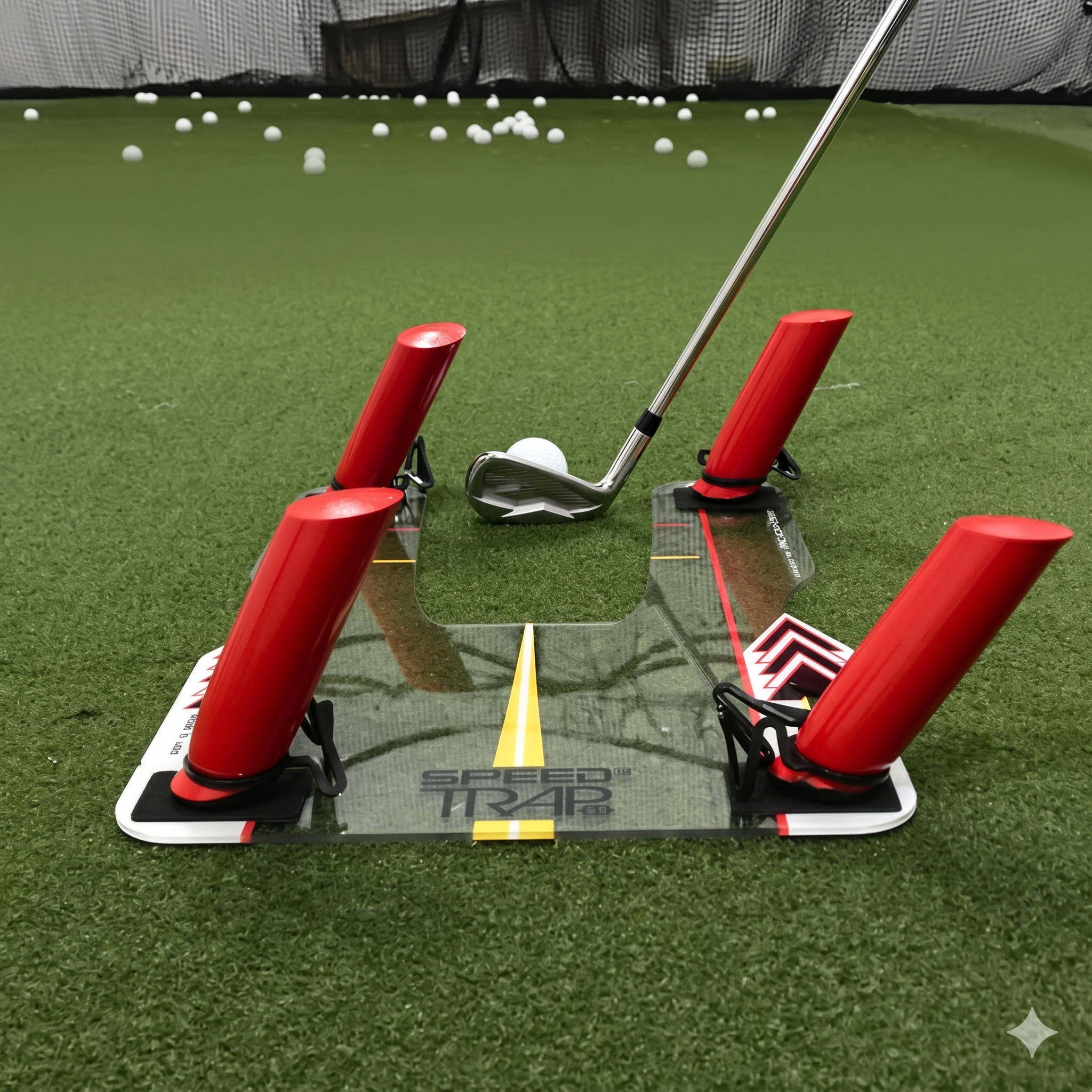
One Amazon reviewer — a 10-to-12 handicapper who’d tried every aid on the market — described three sequential benefits he didn’t expect: better ball compression from navigating the base plate, dramatically improved swing path, and an unconscious forward press that developed naturally from learning to avoid the rods. A 57-year-old reviewer reported that fixing his swing path also trained an inside-out attack angle that delivered the driver distance gains he’d been chasing for years.
The Critical Limitation: Diagnosis vs. Disclosure
Here’s the honest caveat that matters most: the Speed Trap tells you what went wrong. It never tells you why. If you hit a rod on the right, you know the club came across the ball. What caused that — your takeaway, your shoulder turn, your grip, your weight shift — the device has no idea. It’s a symptom reporter, not a root-cause analyzer.
Practical Golf’s Jon Sherman put it plainly: pairing the device with video recording or instructor feedback is essential. Without context, users risk building compensations — swinging with an exaggerated inside takeaway to avoid the outer rod, for example, which fixes one problem while creating another. This is not a dealbreaker, but it is the most important thing to understand before you buy.
What the Speed Trap Does NOT Fix
- ✗Thin or topped shots: The base catches fat strikes, the rods catch path errors — skulls that pass through the channel get a free pass
- ✗Grip issues: Zero feedback on hand position or pressure
- ✗Clubface angle: Guides path, not face orientation at impact
- ✗Root-cause diagnosis: It reveals the fault — it can’t explain what’s causing it
Effectiveness Score
Highly effective for path correction; pair with video or instruction
Ease of Use: Simple Setup, Psychologically Demanding
✓ The Good: Plug-and-Play Hardware
Setup takes 1–2 minutes: lay the base on the mat, insert foam rods into the appropriate holes for your shot shape, align to target, and swing. No batteries, no apps, no calibration. Mechanically, this could not be simpler.
✗ The Hard Part: Actually Swinging
Looking down at a polycarbonate plate with foam rods inches from your impact zone is, as multiple users put it, “very intimidating.” Many golfers describe their first several sessions as humbling to the point of frustration.
“I nearly jumped out of my socks with the noise of my eight iron smacking the baseplate. I decided that the first swing was just a fluke and tried another with the same result.”
— Jon Sherman, Practical Golf (who continued using it and called it excellent)
The mental battle is real. Physical obstacles near the impact zone create hesitancy. Some golfers describe starting to think about the rods instead of clearing their mind and swinging freely — which is, of course, exactly the opposite of what you want when building repeatable mechanics. For golfers who are easily frustrated or need their practice sessions to feel good, the learning curve here is a genuine barrier.
Practical Notes
| Setup time | 1–2 minutes once you understand the system |
| Mat performance | Works well; base can slide slightly if tee holes don’t align |
| Rod installation | Plastic ties can be stiff and fiddly initially |
| Left/right-handed | Fully interchangeable — no limitations |
| Learning curve | Mechanically simple; psychologically demanding for most golfers |
Ease of Use Score
Simple hardware; the frustration factor is a real barrier
Value Analysis: Is $100+ Worth It vs. a $15 DIY Alternative?
Speed Trap 2.0
$99–$119
Base model retail
With Carry Bag Bundle
~$124.95
Full retail package
DIY Alternative
~$15
Lexan + pool noodles
Let’s be honest: the function can be replicated cheaply. At $99–$119, you’re paying for a polycarbonate base plate and foam rods. Multiple users on Golf Simulator Forum and Reddit have noted you can replicate the basic concept with Lexan sheet ($8 at a hardware store), foam pool noodles (a few dollars), and alignment sticks you likely already own — total cost around $15–$20.
“The plexiglass base seems a little cheap for paying so much — not worth $100 for material quality — but it fixed my swing, so I can’t really complain.”
— Amazon Verified Buyer, First-Time Broke 85
That quote captures the tension perfectly. The value perception is low. The results value can be very high — if it fixes your slice, it’s worth more than any lesson you never booked.
Why Users Pay the Premium Anyway
- 1.Safer for clubs: Soft foam rods won’t damage shafts — a critical advantage over rigid DIY alternatives
- 2.Built-in ball position markers: Consistent setup every single session, something a DIY version can’t replicate
- 3.Works on mats: The weighted base provides meaningful feedback on artificial surfaces where DIY solutions fall apart
- 4.Long-term durability advantage: Unlike the Divot Board ($120+ with $39.99 replacement pads every 1,000–6,000 shots), the Speed Trap base is indefinitely durable
⚠️ Competitive Context: The Tour Striker PlaneMate costs $99–$149 and trains a broader range of swing mechanics. If your issues extend beyond swing path specifically, the PlaneMate’s wider training scope may justify its similar price point more effectively.
Value for Money Score
Performance product at a performance price — results justify it if you commit
Versatility: Beyond the Basic Over-the-Top Drill
Genuinely versatile, and more so than EyeLine’s marketing might suggest. The Speed Trap works across a wide range of practice scenarios:
What It Covers
- ✓Full swing path correction — driver, irons, hybrids (primary use)
- ✓Short game — chipping and pitching with built-in ball position markers
- ✓Shot shaping — adjustable rod configs for draw, fade, or straight
- ✓Mats and natural grass — genuine dual-surface capability
- ✓Pre-round diagnostic — quick path check before tee time, not just heavy practice
What It Doesn’t Cover
- ✗Clubface angle or grip position
- ✗Weight transfer or rotation sequencing
- ✗Thin or topped shot feedback
- ✗Tempo, rhythm, or timing issues
Several users report using the Speed Trap as a pre-round warm-up diagnostic rather than a heavy practice tool — a quick path check before a round without the commitment of a full practice session. That’s a smart use case that extends the product’s value beyond the range.
Versatility Score
Excellent within the path-and-low-point niche; not an all-purpose trainer
How to Get the Most Out of the Speed Trap
If you’re going to invest in this device, these are the practices that separate users who improve from users who abandon it.
Start slow with wide gates
Don’t narrow the rod width until you can consistently clear the wide setting. Many users’ frustration comes from starting too narrow and battering the rods constantly.
Record your swing
The Speed Trap tells you what happened; video tells you why. Even a phone leaned against your bag gives you enough information to understand whether you’re hitting the inner rod because your takeaway is too steep or your transition is over the top. Without this step, you’re practicing reaction without understanding.
Use it in short, focused sessions
Fifteen minutes of deliberate Speed Trap work is more valuable than an hour of frustrated full-swing attempts. When your frustration spikes, step away. Come back. Neurological learning happens in the recovery, not just the repetition.
Use it as a warm-up diagnostic, not just heavy practice
Once you’ve grooved the feedback, even five swings before a round tells you whether your path is on that day. Multiple users report this as the highest-value ongoing use case once the initial fix has taken hold.
Don’t use it every session forever
This is a training tool for a specific problem. Once your path is fixed, shift your practice energy to other areas. Use the Speed Trap occasionally for maintenance, not as a permanent crutch.
Fairways & Hazards: The Honest Pros and Cons
Fairways (Strengths)
- ✓Instant, unmistakable swing path feedback — zero ambiguity, zero cheating the device
- ✓Proven slice and hook correction backed by real user results across hundreds of reviews
- ✓‘Unbreakable’ polycarbonate base survives 1,000+ sessions without structural failure
- ✓Works with every club — driver to wedge — on mats and natural grass
- ✓Rod tethers (2.0) finally solved the flying-rod embarrassment that plagued v1.0
Hazards (Limitations)
- ✗$99–$119 feels steep versus a $15 DIY foam-noodle and alignment-stick alternative
- ✗Tells you what went wrong — never why. Diagnosis without root-cause analysis
- ✗Steep learning curve — many golfers abandon this before progress clicks
- ✗No feedback for thin or topped shots — those pass through the channel penalty-free
FAQ: Your EyeLine Speed Trap 2.0 Questions Answered
Does the EyeLine Golf Speed Trap 2.0 actually fix a slice?
For slices caused by an out-to-in swing path, yes — it’s one of the most effective tools available. Multiple users report significant improvement or elimination of their slice within weeks of consistent use. However, if your slice is caused by an open clubface at impact rather than swing path, the Speed Trap addresses a symptom, not your actual root cause. Getting a lesson diagnosis first will tell you which problem you’re solving.
What’s the difference between the Speed Trap 1.0 and Speed Trap 2.0?
The 2.0 is meaningfully better. Key upgrades include: tethered foam rods (so they don’t fly across the range when struck), a wider base slot accommodating driver practice, stronger polycarbonate construction, brighter alignment markings, and an included carry bag. If you’re buying new, there’s no reason to consider the 1.0.
What is the Speed Trap 4S, and should I buy it instead?
The Speed Trap 4S is EyeLine’s compact model designed to fit inside a golf bag. It has four sides for different shot configurations. The 4S solves the portability complaint about the 2.0. If portability is important to you, it’s worth considering. If you’ll primarily use it at a fixed location (home net or regular range), the 2.0’s wider base gives more feedback surface.
Can I use the Speed Trap on artificial turf / driving range mats?
Yes — this is one of its genuine advantages over some training aids. Multiple users specifically note that the base provides meaningful fat-shot feedback on mats, where a club would normally bounce rather than stick. On mats without aligned tee holes, the base can slide slightly, which is a minor but manageable annoyance.
Is there a cheaper alternative to the EyeLine Speed Trap?
Yes — a DIY version using Lexan sheet, pool noodles, and alignment sticks can replicate the basic concept for $15–$20. The EyeLine version offers advantages: softer foam that won’t damage clubs, built-in ball position markers, consistent setup, and a carry bag. Whether those advantages justify an $80–$100 premium is a personal decision based on how seriously you take your practice.
Will the Speed Trap help me hit the ball farther?
Not directly — it’s not marketed as a distance trainer. However, correcting an out-to-in path that causes a slice can indirectly deliver distance gains by allowing proper clubhead delivery through impact. One Amazon reviewer specifically noted improved driver distance after fixing his attack angle through Speed Trap use. Results will vary based on your current path issues.
How long does it take to see results with the Speed Trap?
Highly variable, but consistent users report path awareness within the first session and measurable on-course improvement within 3–5 dedicated practice sessions. One Amazon reviewer broke 85 for the first time after three one-hour sessions. Others take weeks. The key variable is how consistently you practice and whether you understand why your path is off — not just that it is.
Is the EyeLine Speed Trap good for beginners?
With caveats. Complete beginners without any swing foundation may find the feedback becomes noise — they don’t yet have enough context to understand what the rods are telling them. It works better for golfers who have developed basic mechanics but have developed a persistent path fault. If you’re a beginner, a lesson first would help you get significantly more out of this device.
Does it work for left-handed golfers?
Yes — the rod positions are fully interchangeable, and the base works identically for left- and right-handed setups. No modifications or special accessories are required.
Can I use the Speed Trap at home in a net?
Yes, and this is one of the best use cases. Without the distractions of a busy range, you can set up, swing slowly, and focus on the feedback. A net plus Speed Trap is one of the most effective home practice setups available at this price point — especially valuable for year-round practice during winter months.
The Bottom Line: Who Should Buy the EyeLine Speed Trap 2.0?
Buy It If You Are:
- ✓A mid-to-high handicapper (15–36+) fighting a chronic slice or hook you can’t shake on your own
- ✓A visual learner who responds better to physical gates than verbal swing thoughts
- ✓Willing to practice deliberately — you’ll commit to multiple sessions, not just one frustrated bucket
- ✓Pairing it with video analysis or instruction so you can understand why you’re hitting the rods, not just that you are
- ✓A lower handicapper who wants a maintenance tool and pre-round diagnostic for path
Pass on It If You Are:
- ✗A raw beginner without any swing foundation — the feedback becomes noise without context
- ✗Primarily fighting a grip or clubface issue rather than a path issue — this device won’t solve those problems directly
- ✗Easily frustrated and need your practice to feel good — the learning curve will likely beat you
- ✗Budget-conscious and willing to DIY — a $15 foam noodle and alignment stick setup replicates the basic concept
- ✗Someone whose primary miss is thin or topped shots — the Speed Trap has nothing to say to you on those
Final Scoring
| Category | Score | Max |
|---|---|---|
| Effectiveness | 26 | 30 |
| Build Quality & Durability | 18 | 20 |
| Ease of Use | 13 | 20 |
| Value for Money | 15 | 25 |
| Versatility | 4 | 5 |
| TOTAL | 76 | 100 |
The Bottom Line
The EyeLine Golf Speed Trap 2.0 has earned its status as one of the most respected swing path trainers on the market through one simple mechanism: it works. Across hundreds of real user reports, the pattern is consistent — initial frustration, gradual understanding, measurable improvement for golfers who persist. Treat it as a diagnostic tool, not a teaching tool. It reveals path faults with brutal clarity but offers no explanation for their cause. Pair it with video or instruction, commit to multiple sessions, and the Speed Trap delivers. Buy it expecting a one-bucket miracle and it’ll join the golf graveyard in your garage.
⛳ The 19th Hole: Final Verdict
The EyeLine Golf Speed Trap 2.0 is one of the most brutally honest swing path trainers on the market — it genuinely works, but it will humble you before it helps you.
Birdie Score: 76/100