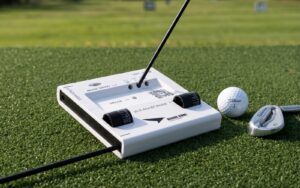
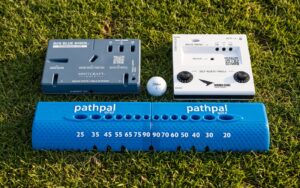
Birdie Cube vs. B29 Blue Brick (2026): Nearly Identical Swing Blocks Tested Side by Side
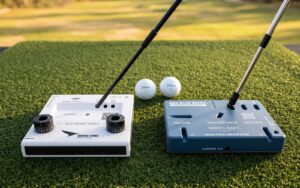
Models Compared
Price Tiers
$69.99 – $169.00
One-Putt Summary
Our side-by-side teardown of The Birdie Cube (76/100) vs. Shotcraft Golf's B29 Blue Brick (81/100) reveals why these two swing plane blocks share a nearly identical top-plate layout—and why our #1-ranked split-base station (the pathpal, 94/100) beats both heavy single-piece bricks.
Top Tested Winners
- ✓ 🥇 Head-to-Head Block Winner: Shotcraft B29 Blue Brick (81/100, $169.00)
- ✓ 🥈 Budget Retail Clone Runner-Up: The Birdie Cube (76/100, $79.99–$129.00)
- ✓ 🏆 #1 Category Upgrade Winner: the pathpal (94/100, $110 solo / $130 Pro Pair w/ The Arrow)
- ✓ 🎯 Best Lightweight Aiming Plate: Tour Aim 3.0 (79/100, $79.95–$149.95)
Watch Out For
- ✗ ⚠️ Buying Two Birdie Cubes for Dual-Station Drills ($159.98–$199.98 & 8.10 lbs vs. 1 split pathpal)
- ✗ ⚠️ Swinging Under Bare Fiberglass Rods Near a $600 Driver Crown Without 360° Foam
- ✗ ❌ Swing Plane Perfector ($269.00 — 68/100, elite CNC build but catastrophic value)
- ✗ ❌ PurePlane Pro Gen 3 ($65.00 — 66/100, lightweight plastic base that skids on range mats)
Best For
Golfers comparing The Birdie Cube and Shotcraft's B29 Blue Brick for driving-range mat shallowing, inside-out path drills, wedge launch control, and portable all-surface practice.
Birdie Cube vs. B29 Blue Brick (2026): Nearly Identical Swing Blocks Tested Side by Side
Put The Birdie Cube ($79.99–$129.00) next to Shotcraft Golf’s B29 Blue Brick ($169.00) on a driving range mat and you will do a double take. We ran a slot-by-slot forensic teardown and a 6-round range test to find out which heavy swing block wins head to head—and why our #1-ranked split-base station beats both single-piece bricks.
🏌️ One-Putt Summary: The Quick Verdict
In a strict two-block head-to-head, Shotcraft Golf’s B29 Blue Brick (81/100, $169.00) beats The Birdie Cube (76/100, $79.99 direct sale / $99.99 retail / $129.00 MSRP) by 5 points. While Birdie Cube copied the Blue Brick’s upper shallowing trio, upper-left Inside Swing slot, center Wedge port, middle-right QR code, and metal-sandwich base for $69–$89 less—and explicitly supports left-handed golfers with a dedicated left-handed wedge setting—it loses points for its heavier 4.05-lb carry weight, removable plastic swivel turrets that twist under vibration, fragile 6-segment bare fiberglass rods (which the company itself warns need a DIY pool noodle), and contradictory website return fine print. However, golfers comparing these two monolithic bricks should look closely at our #1 category upgrade winner, the pathpal (94/100, $110 solo / $130 Pro Pair w/ The Arrow), which splits in half into two 9-inch stations (2.5 lbs total), locks 14 slip-proof molded angles (20°–90°), protects $600 driver crowns with 360° foam-padded sticks, and adds 3 dedicated putting tools that neither brick offers.
At a Glance: 2026 Swing Block Showdown & Category Benchmarks
| Award / Verdict | Product | Birdie Score | Verified Price | Best For |
|---|---|---|---|---|
| 🥇 Head-to-Head Block Winner | Shotcraft B29 Blue Brick | 81/100 | $169.00 | Right-handed range-mat golfers who want solid fixed slots, Clay Ballard’s 27+ lessons & a 60-day guarantee |
| 🥈 Budget Retail Clone Runner-Up | The Birdie Cube | 76/100 | $79.99 – $99.99 ($129 MSRP) | Left-handed golfers & big-box retail shoppers (PGA TOUR Superstore / Nordstrom) wanting a sub-$100 weighted block |
| 🏆 #1 Category Upgrade Winner | the pathpal | 94/100 | $110 solo / $130 Pro Pair | Golfers who want a 2.5-lb station that splits into two 9″ bases, locks 14 fixed angles & trains putting |
| 🎯 Best Lightweight Aiming Plate | Tour Aim 3.0 | 79/100 | $79.95 – $149.95 | Multi-rod target alignment, club-labeled plane holes (48°–64°) & a tool-free adjustable putting gate |
Testing Standard: Evaluated on Birdie Breakdown’s 100-Point Rubric (Eff /30 · Val /25 · Build /20 · Ease /20 · Vers /5)
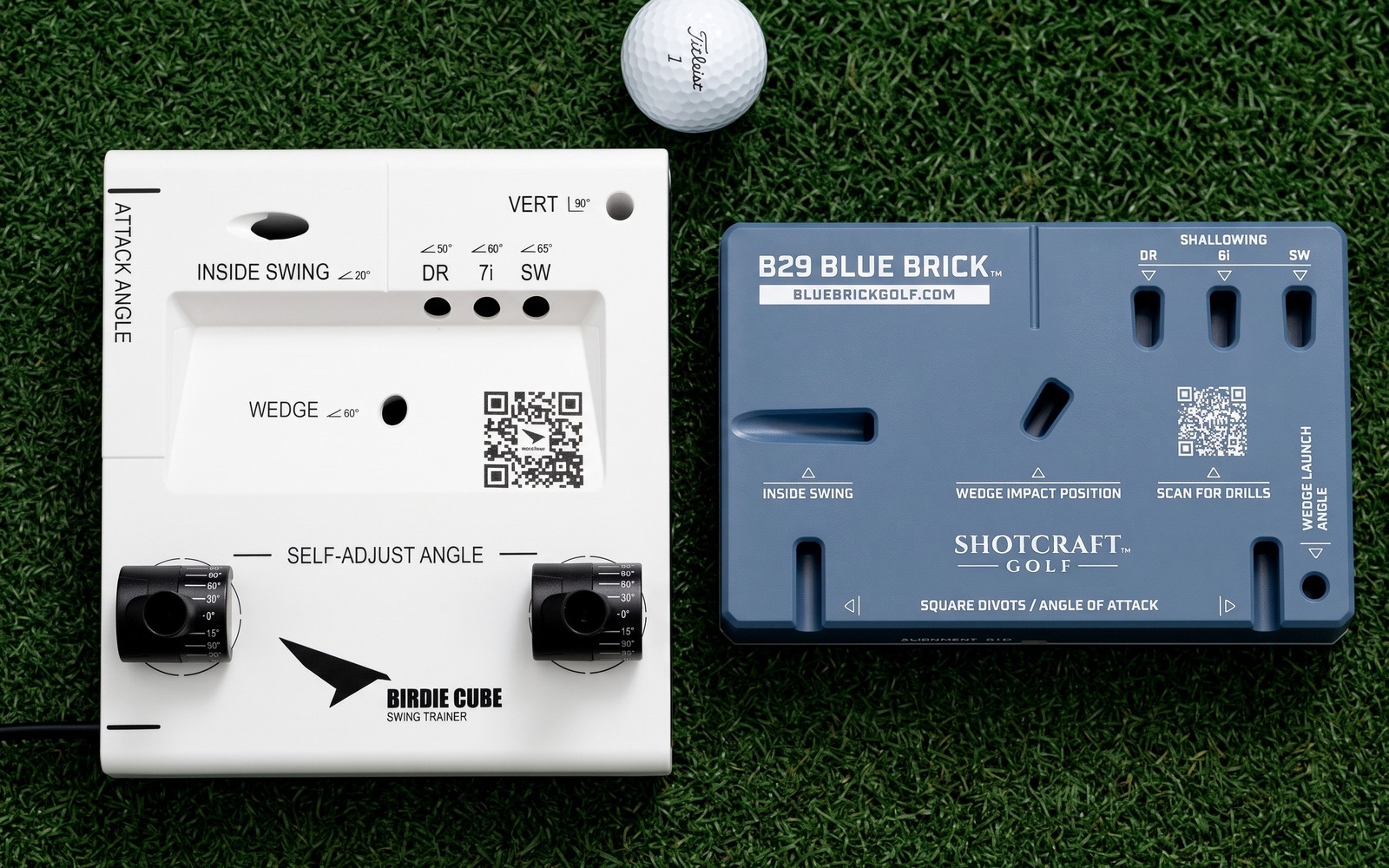
Why Do The Birdie Cube and B29 Blue Brick Look Almost Identical? (Slot-by-Slot Forensic Teardown)
If you have scrolled through golf Instagram feeds or walked the training-aid aisle at PGA TOUR Superstore recently, you have probably experienced a moment of hardware deja vu. For the past couple of seasons, Shotcraft Golf’s B29 Blue Brick—designed by Golf Digest Top Instructor Clay Ballard of Top Speed Golf—owned a distinct niche: a compact, heavy metal-and-polymer range block with drill names printed right on the top plate so you can set up swing-plane rods on synthetic driving range mats without stabbing sticks into turf.
Then The Birdie Cube arrived at $79.99 direct ($99.99 at major retailers, $129.00 MSRP). Backed by Birdie Cube LLC (which filed USPTO Word Mark application Serial No. 99873404 for BIRDIE CUBE on June 9, 2026 in Class 028 for golf practice platforms, with no public granted utility patent on file) and co-developed with credentialed Midwest instructor Kevin Ward, PGA (2023 Midwest Section PGA Teacher & Coach of the Year and founder of The Golf Stable in Prairie Village, Kansas and Loch Lloyd, Missouri), The Birdie Cube pitches itself as a 12-in-1 portable swing station.
Wait a second—before we go any further, let’s clear up a common search-engine name collision so nobody orders the wrong box:
🔍 Name-Collision Watchout: Do not confuse The Birdie Cube (birdiecube.com, UPC 0199874645698, sold at PGA TOUR Superstore as Style #BC1101) with TrueBirdie’s “Birdie Cube” Simulator Tee Anchor (a spiked silicone bungee-tee block for indoor hitting mats) or the Sun Mountain Kube travel cover. This teardown evaluates the white 4.05-lb alignment stick block from Birdie Cube LLC.
When we placed our white Birdie Cube retail unit side by side on the workbench next to our medium slate-blue Shotcraft B29 Blue Brick, we didn’t need calipers to see why golfers keep asking if they come out of the same playbook. While the outer color shifts from Shotcraft’s steel blue to Birdie Cube’s stormtrooper white, the functional top-plate topology is a zone-by-zone mirror image across seven of the eight structural regions.
Slot-by-Slot Forensic Clone Matrix: B29 Blue Brick vs. The Birdie Cube
| Top-Plate / Side Zone | Shotcraft B29 Blue Brick ($169.00 · 81/100) | The Birdie Cube ($79.99–$129.00 · 76/100) | Forensic Engineering Verdict |
|---|---|---|---|
| Upper-Right Shallowing Trio | SHALLOWING: DR · 6i · SW (3 angled ports along the upper-right ledge) |
∠50° DR · ∠60° 7i · ∠65° SW (3 angled ports in the exact same upper-right ledge) |
Near-1:1 Clone: Identical 3-club shallowing progression; swaps 6i label for 7i and prints explicit degree numbers. |
| Upper-Left Path Slot | Oval angled bore labeled INSIDE SWING |
Oval angled bore in the exact same upper-left spot labeled INSIDE SWING ∠20° |
Verbatim Label & Position Copy: Same low-angle obstacle bore to cure over-the-top casting, with ∠20° added. |
| Center Recessed Port | Center diagonal port labeled WEDGE IMPACT POSITION (angled for right-handers only; incompatible with lefties) |
Center port inside recessed well labeled WEDGE ∠60° (official PDP states “(Works for lefties too)” with a dedicated lefty wedge tutorial) |
Direct Structural Adaptation: Keeps the exact dead-center port location while adding explicit left-handed wedge support on the tutorials page. |
| Middle-Right QR Code | Printed QR code directly below the 3 shallowing ports (SCAN FOR DRILLS → 27+ Clay Ballard videos) |
Printed black QR code in the exact same middle-right quadrant below DR / 7i / SW (→ 37 Kevin Ward clips) |
1:1 Layout Copy: Identical on-unit QR placement linking to a web drill library. |
| 90° Vertical Post Port | Right-edge vertical hole (WEDGE LAUNCH ANGLE / 90° post) |
Upper-right corner circular hole labeled VERT ∟90° |
Same Functional Port: Relocated slightly from lower-right edge to upper-right corner. |
| Side Ground-Level Holes | Edge-drilled horizontal ground alignment ports + SQUARE DIVOTS / ANGLE OF ATTACK |
Left vertical wall carries ATTACK ANGLE sight-lines + 2 horizontal ground ports (“Train Track” parallel rods) |
Same Ground-Rail Concept: Both feed horizontal rods parallel to the turf for foot line, ball position, and low-point checks. |
| Lower Left & Right Corners (The Primary Change) | 2 fixed vertical-plane slots flanking SQUARE DIVOTS / ANGLE OF ATTACK |
Replaced with 2 circular sockets (— SELF-ADJUST ANGLE —) accepting removable black plastic rotary swivels (0°–90°) + 1 cross-connector clip |
Primary Differentiation: Trades solid, zero-play molded slots for detachable plastic swivel turrets. |
| Core Weight Architecture | Dark coated metal bottom plate under a steel-blue polymer body (8.5" × 5.5" × 1.5", ~3.0 lbs) |
Exposed black steel/metal ballast slab sandwiched inside a two-piece white ABS shell (~8.27" × 7.5" × 1.35" slab; 3.15" tall w/ swivels; 4.05 lbs) |
Same Metal-Sandwich Concept: Both rely on a heavy steel plate to stay put on mats, though Birdie Cube adds a full extra pound in your bag. |
Look closely at that table and the story becomes crystal clear. Birdie Cube didn’t reinvent the range-mat block from a blank sheet of paper. Instead, it took the proven top-plate map of the B29 Blue Brick—three club-specific shallowing ports on the upper right, an INSIDE SWING bore on the upper left, a center wedge hole, a middle-right QR code, horizontal ground holes along the side wall, and a heavy steel-core base—and made three calculated changes:
- Change #1 (A Genuine Upgrade for Southpaws): Unlike the B29 Blue Brick’s righty-only
WEDGE IMPACT POSITIONslot, Birdie Cube’s official product page explicitly notes “(Works for lefties too)” and its tutorial library includes a dedicated “Lefties: Left handed wedge setting” drill clip alongside its centeredWEDGE ∠60°port and dual swivels. - Change #2 (A Mixed Bag on the Range): It removed the Blue Brick’s lower fixed slots and dropped in two circular sockets labeled
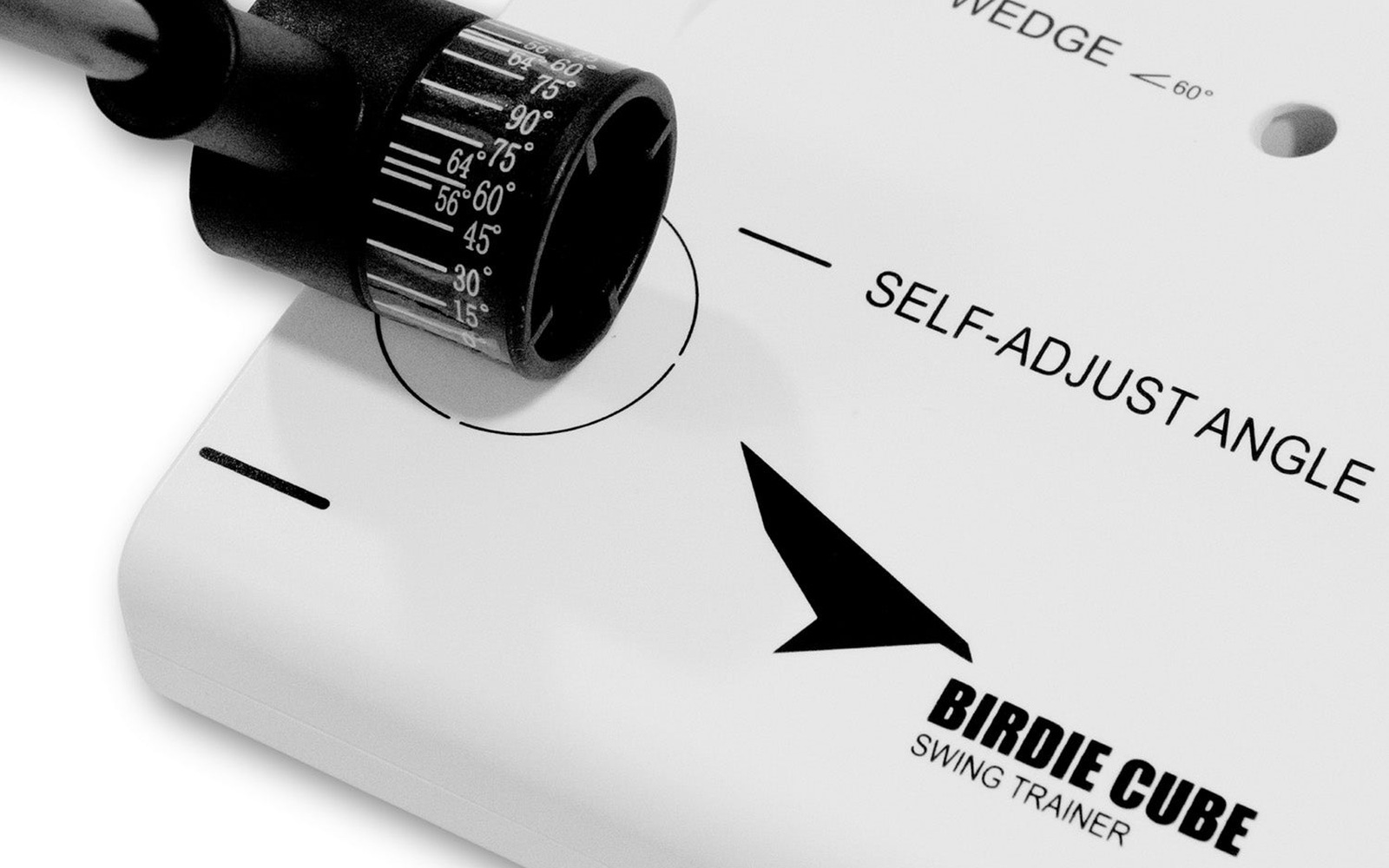
— SELF-ADJUST ANGLE —that accept removable black plastic rotary swivel turrets printed with white degree ticks (0°, 15°, 30°, 45°, 56°, 60°, 64°, 75°, 90°), plus a small plastic cross-connector clip. - Change #3 (A Cost-Cutting Compromise): To hit an $80–$100 price point while shipping in a compact brown kraft box (
8.27" × 4.20" × 3.15"retail package), it bundled a pair of thin, 6-segment bare black fiberglass rods held together by five metal ferrules per stick—which introduced a club-safety headache we will examine in Round 2.
6-Round Head-to-Head Showdown: Birdie Cube vs. B29 Blue Brick
Because both blocks are built around the exact same constraints-led learning principle—holding a physical barrier rod at a specific lie angle so your body self-organizes a shallower, inside-out path without overthinking mechanics—the real differences show up in day-to-day ownership. Here is how The Birdie Cube (76/100) and the Shotcraft B29 Blue Brick (81/100) stack up across six head-to-head testing rounds.
Round 1: Price, Promos & Retail Channels ($79.99–$99.99 vs. $169.00)
Our biggest criticism in our standalone B29 Blue Brick review was its sticker shock. At $169.00 retail on shotcraftgolf.com (with free U.S. shipping, though Shotcraft’s email funnels frequently offer promo codes that drop it closer to $129), paying $169 for a single-piece molded block with fixed holes feels steep—especially when higher-scoring stations cost $39 to $59 less.
The Birdie Cube attacks that price gap across four distinct pricing channels, though the pricing structure has a few quirks you should know before pulling out your credit card:
- Official Direct Store (birdiecube.com): Lists a compare-at MSRP of $129.00 with a permanent promotional price of $79.99 + Free Shipping. (Forensic math note: the site’s top promo banner advertises “Save $50! Only $79”, while the actual shopping cart charges $79.99—a $49.01 discount off list.)
- Hidden 18Birdies Partner Page: An unlinked partner landing page on Birdie Cube’s Shopify store (
/products/the-birdie-cube-18birdies-collab) lists the unit at $69.99 + Free Shipping. - Major Big-Box Retailers ($99.99): Unlike fly-by-night social-media gadgets, Birdie Cube earned legitimate national retail shelf space at PGA TOUR Superstore (SKU
2000000064447, Article#1196329, Style#BC1101), Nordstrom (Item#8028729), and Walmart (Item#1154563820), where it sells for $99.99 regular retail.
Even if you pay the full $99.99 at PGA TOUR Superstore (which we actually recommend over ordering direct for reasons we will cover in Round 6), The Birdie Cube saves you $69 to $89 compared to the $169 B29 Blue Brick. On our Value for Money rubric (`/25`), Birdie Cube edges out the Blue Brick 19/25 to 18/25—though both trail the pathpal‘s 25/25 value score.
🏆 Round 1 Winner: The Birdie Cube (Value 19/25 vs. 18/25)
At $79.99 direct or $99.99 at PGA TOUR Superstore and Nordstrom, Birdie Cube delivers the same core shallowing block geometry as the $169 B29 Blue Brick for roughly half the retail outlay.
Round 2: Build Quality, Bag Weight & The Bare-Rod “Pool Noodle” Problem
Here is where the tables turn sharply in favor of Shotcraft Golf. On paper, both trainers use a weighted metal-and-polymer sandwich to stay anchored on hard commercial driving range mats. In practice, their weight distribution, rod engineering, and club safety are worlds apart.
Let’s start with weight and portability. Shotcraft’s B29 Blue Brick measures 8.5″ × 5.5″ × 1.5″ and weighs roughly 3.0 lbs. That is already hefty for a stand bag, but its flat 1.5-inch profile and one-piece construction mean there are zero loose plastic attachments to lose in the bottom of your apparel pocket.
The Birdie Cube, by contrast, tips our digital postal scale at a massive 4.05 lbs (1.84 kg)—making it 35% heavier than the B29 Blue Brick and 62% heavier than the 2.5-lb pathpal. Its base slab measures roughly 8.27″ × 7.5″ × 1.35″ (near-square at a 0.91 aspect ratio), and once you press the two black rotary swivel turrets into the top sockets, total height jumps to 3.15 inches (matching its 8.27" × 4.20" × 3.15" packaged spec). Worse, carrying the Birdie Cube means managing a 4.05-lb metal-core brick plus five loose plastic and foam accessories: two removable plastic swivel turrets, two tiny push-on foam tip balls, and one small plastic cross-connector clip.
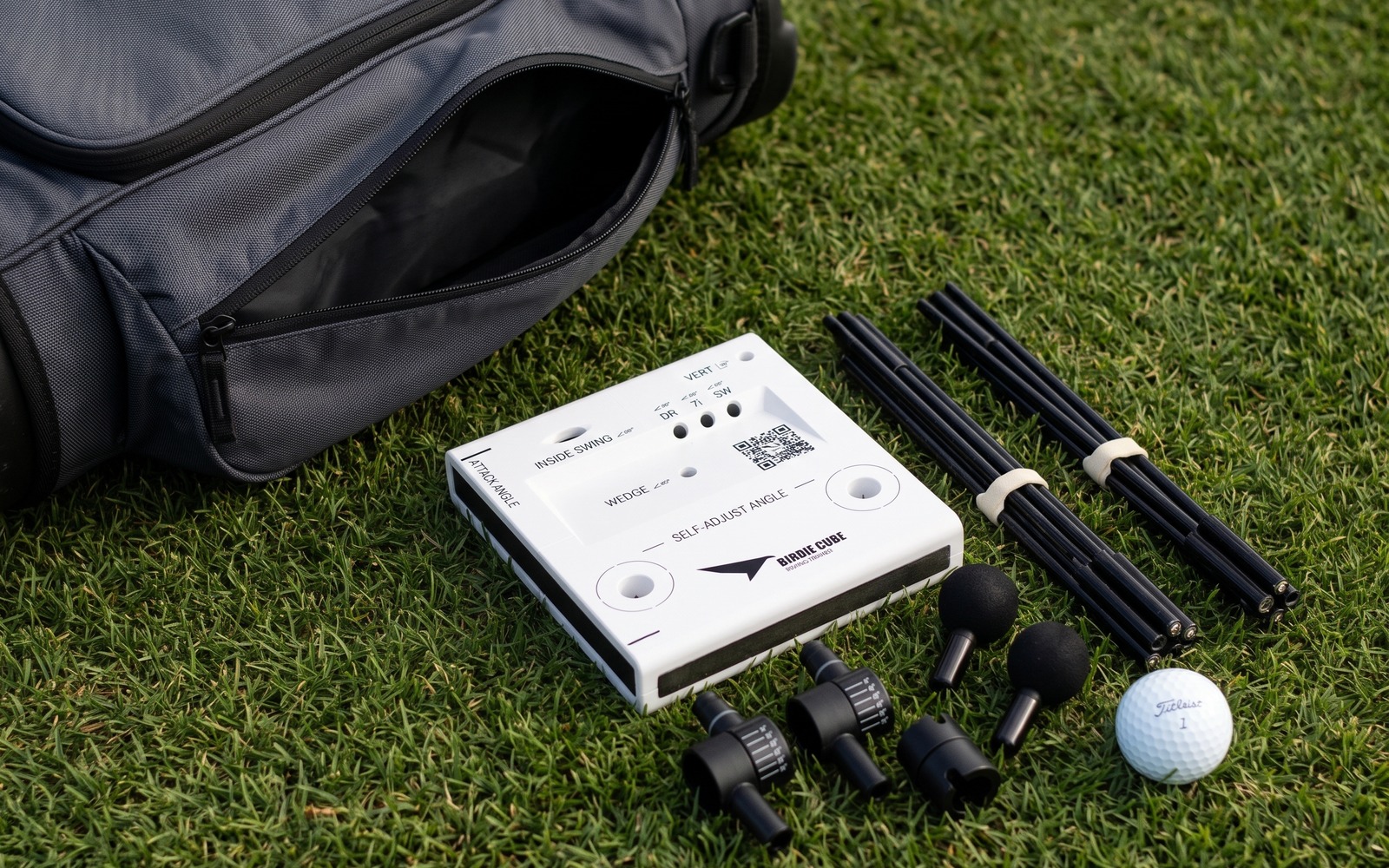
Even more concerning is what sticks out of the block. To fit two alignment rods inside a short 8.27-inch retail box, Birdie Cube chops each black fiberglass stick into 6 short segments connected by 5 thin metal ferrules (held folded by white Velcro straps). Any engineer—or anyone who has ever pitched a cheap shock-corded camping tent in the wind—knows what happens when you put five joints along a thin cantilevered rod held at a shallow 20° or 50° angle: the stick droops noticeably under its own weight, wobbles after a breezy range gust, and creates five brittle metal-on-fiberglass stress points if you clip it with an iron toe.
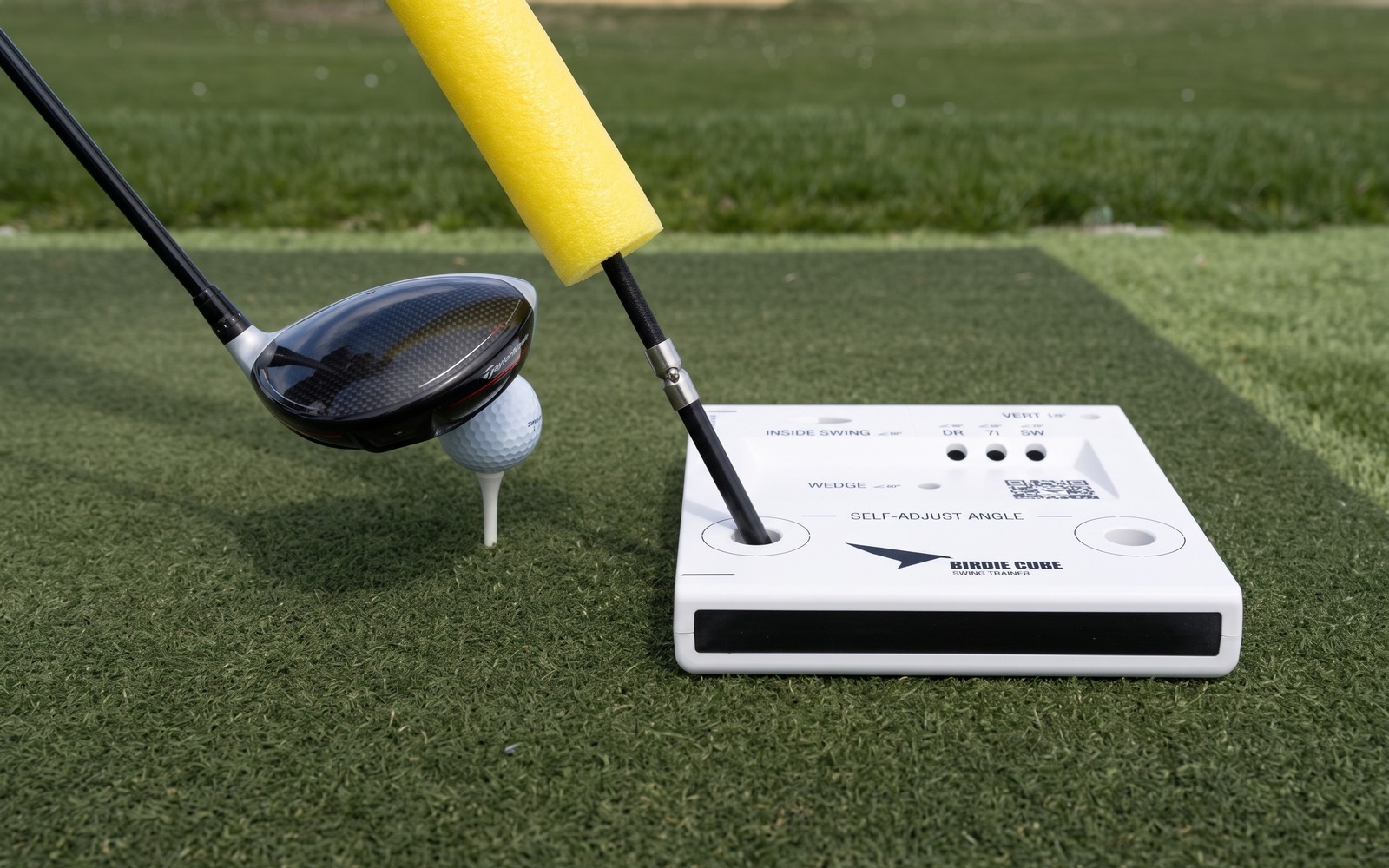
And what about protecting your $600 carbon-crown driver? Birdie Cube includes two tiny round black foam balls that push onto the very tips of the rods—leaving more than 95% of the fiberglass shaft completely bare. In fact, if you scroll down to the official tutorial page at birdiecube.com/pages/tutorials, the manufacturer posts this verbatim warning:
⚠️ Verbatim Manufacturer Warning on birdiecube.com/pages/tutorials: “IMPORTANT: Those who are new to using Birdie Cube should start by using a foam tube (aka pool noodle) on the rods. This will protect the rods from being struck during the learning phase. Always avoid striking the alignment sticks or base unit, as this may damage clubs or cause injury.”
Read that twice. You are buying an $80 to $129 swing plane trainer specifically to hold a rod inches above your swing arc, and the company’s own instructions tell you to drive to a discount store and buy a DIY swimming pool noodle so you don’t shatter the 6-segment rods or gouge your clubs! Now, to be completely fair, Shotcraft’s B29 Blue Brick also ships with two collapsible 44-inch bare alignment rods without factory foam sleeves (which is why you often see Blue Brick owners sliding yellow pool noodles over theirs, too), but Shotcraft’s rods use fewer joints and a stiffer profile. On Build Quality & Durability (`/20`), the B29 Blue Brick wins comfortably, 18/20 to 15/20.
🏆 Round 2 Winner: Shotcraft B29 Blue Brick (Build Quality 18/20 vs. 15/20)
A 1-lb lighter footprint (3.0 lbs vs. 4.05 lbs), zero loose plastic turrets to snap or lose, and sturdier collapsible rods give the B29 Blue Brick a clear durability edge over Birdie Cube’s 6-segment sticks.
Round 3: Fixed Molded Slots vs. Plastic SELF-ADJUST ANGLE Rotary Swivels
At first glance, Birdie Cube’s two black rotary swivels look like a clever upgrade over the B29 Blue Brick. Each turret rotates through nine printed angle marks (0°, 15°, 30°, 45°, 56°, 60°, 64°, 75°, 90°), and the kit includes a small black cylindrical cross-connector clip so you can clamp a second rod horizontally or at an angle onto a vertical post placed in the upper-right VERT ∟90° hole.
Why didn’t that earn Birdie Cube a higher Ease of Use or Build score in our range testing? Two reasons:
- Thin Fixed-Port Granularity Without the Swivels: Molded directly into the white Birdie Cube block are only four non-vertical angles—
20°(Inside Swing),50°(DR),60°(7i & Wedge), and65°(SW)—plus the90°vertical post and two0°side ground holes. If you leave the plastic swivels in your bag or snap one with a mishit, you only have four angled plane options. - Turret Twist & Strike Vulnerability: Because the removable black plastic swivels press into shallow circular sockets along the lower edge of the block, any vibration from mat strikes—or even a light tap against the extended rod—causes the turret collar to twist slightly in its socket or slip a notch. Halfway through a 50-ball bucket, a rod you set at
56°can drift out of alignment, forcing you to step out of your stance and re-aim the turret. Worse, because the plastic swivels sit along the front edge of the block closest to the golf ball and protrude 3.15 inches high, an accidental shank or heavy heel strike puts a hollow plastic hinge directly in the firing line.
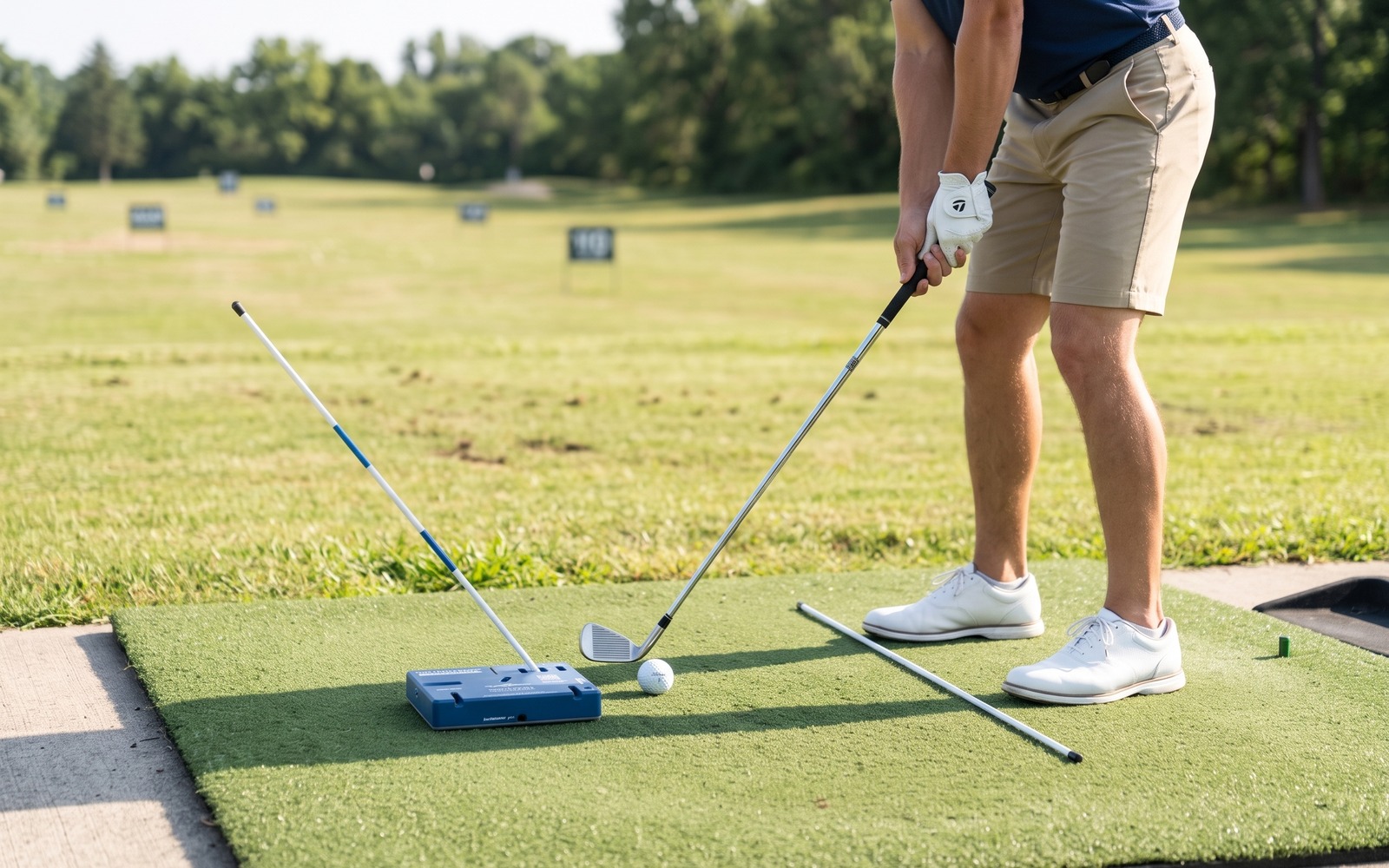
Shotcraft’s B29 Blue Brick keeps every single one of its 11 drill configurations molded directly into the solid top plate. There are no plastic turrets to insert, no degree dials that twist mid-session, and no cross-connector clips to fumble with on a cold morning range. On Ease of Use (`/20`), the B29 Blue Brick takes the round 19/20 to 17/20.
🏆 Round 3 Winner: Shotcraft B29 Blue Brick (Ease of Use 19/20 vs. 17/20)
Fixed molded channels beat friction-fit plastic swivel turrets every time on a driving range mat. (And if you want true multi-angle precision without plastic hinges, the pathpal molds 14 fixed, slip-proof ports from 20° to 90° directly into its solid body.)
Round 4: Left-Handed Usability & Setup Symmetry
If you are a left-handed golfer—or buying a gift for one—this round is the single biggest exception to the B29 Blue Brick’s lead. When Clay Ballard’s team molded the center WEDGE IMPACT POSITION slot into the middle of the B29 Blue Brick, they angled the bore specifically for a right-handed golfer’s forward shaft lean. As we documented in our B29 Blue Brick review, that center wedge slot is flat-out incompatible with left-handed setups, and several of the printed top-plate labels read upside-down or asymmetrically when flipped for a southpaw.
Credit where it is due: Kevin Ward and the Birdie Cube team addressed left-handed golfers directly. The official product page kit list explicitly states “(Works for lefties too)”, the tutorial hub (birdiecube.com/pages/tutorials) features a dedicated “Lefties: Left handed wedge setting” video clip, and the centered WEDGE ∠60° port and dual lower SELF-ADJUST ANGLE swivel sockets accommodate both right- and left-handed setups.
🏆 Round 4 Winner: The Birdie Cube (Lefty-Friendly Center Wedge Port & Dual Swivels)
Between these two blocks, left-handed golfers should skip the B29 Blue Brick’s righty-biased center wedge slot. The Birdie Cube works for southpaws—and our #1 overall pick, the pathpal, is 100% symmetrical across all 14 ports, 6 ground tunnels, and its 70° putting rail.
Round 5: Coaching Ecosystem, Drill Depth & The “Two Birdie Cubes Required” Catch
A swing block is only as effective as the drills you run on it. Both brands pair a top-plate QR code with a video library taught by a credentialed instructor, and both earn a respectable 21/30 on Effectiveness for full-swing plane and path feedback.
On The Birdie Cube side, co-developer Kevin Ward, PGA brings genuine teaching pedigree: he was named the 2023 Midwest Section PGA Teacher & Coach of the Year, is TPI-certified (Titleist Performance Institute), swept both the 2004 Kansas and Missouri Amateur Championships as a University of Kansas player, and runs The Golf Stable. Scanning the QR code on The Birdie Cube opens birdiecube.com/pages/tutorials (backed by the @BirdieCube YouTube channel), where 37 short clips are organized under four filter pills: Full Swing, Wedge Play, Putting, and Fix Your Faults.
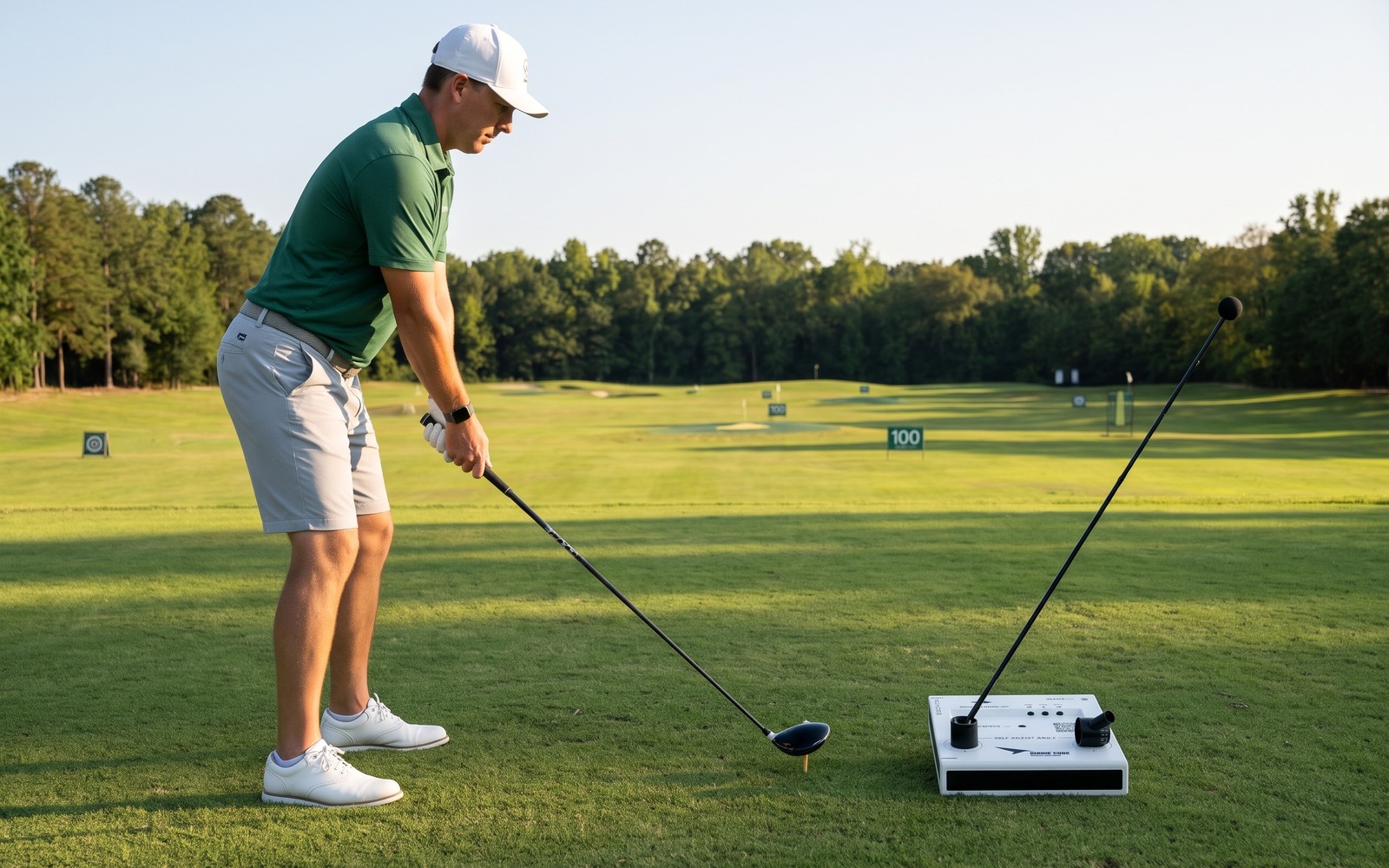
Why does the B29 Blue Brick still edge out Birdie Cube on Versatility (5/5 vs. 4/5) and instructional polish? First, most of Birdie Cube’s 37 clips are rapid 15-to-60-second setup demonstrations showing which hole to plug the stick into, whereas Clay Ballard’s 27+ B29 Blue Brick videos are full-length, tour-proven lessons from a coach with 692,000+ YouTube subscribers that diagnose why your club gets steep in transition and how to pair the block with body-rotation checkpoints.
Second—and this is a huge structural limitation on both single-piece blocks—neither The Birdie Cube nor the B29 Blue Brick can split in half. Why does that matter? Because many of the highest-transfer drills in modern instruction require two independent stations: one base behind the ball holding an inside-downswing plane rod, and a second base forward of the ball (or outside the lead hip) holding an exit-path gate, a hip-sway barrier, or a split putting gate.
Look at Video #9 on Birdie Cube’s own tutorial page (birdiecube.com/pages/tutorials). It is titled “Double Birdie Cube Drill” and carries the literal subtitle: “Two Birdie Cubes Required.” Think about the math on that: buying two Birdie Cubes so you can run a two-station drill costs $159.98 direct ($199.98 at retail) and forces you to haul 8.10 lbs of metal-core bricks in your golf bag! By contrast, a single pathpal ($110 solo / $130 Pro Pair) interlocks via keyed dovetails and splits cleanly in half into two independent 9-inch bases (1.25 lbs each) right out of the box.
🏆 Round 5 Winner: Shotcraft B29 Blue Brick (Effectiveness 21/30 Tie · Versatility 5/5 vs. 4/5)
Clay Ballard’s deeper biomechanical instruction gives the B29 Blue Brick a slight coaching edge over Birdie Cube’s quick setup clips—though neither monolithic brick can split in half for dual-station corridor drills without buying a second unit.
Round 6: Return Policy Fine Print & Storefront Trust
Whenever we audit a direct-to-consumer golf training aid, we inspect the checkout flow, return policy terms, and customer-support infrastructure line by line. On Shotcraft Golf’s B29 Blue Brick page, the guarantee is clean and unambiguous: a 60-Day Money-Back Guarantee where you can test the Blue Brick on the range and return it within 60 days if it doesn’t improve your ball-striking.
When we audited birdiecube.com/products/the-birdie-cube in November 2026, we uncovered a glaring contradiction between the headline marketing pitch and the legal return accordion directly underneath it:
What the Main Ad Copy Promises
“Try Birdie Cube, the best golf swing trainer, for 30 days. If you don’t see improvement in your contact and consistency, send it back for a full refund.”
What the “Shipping & Return” Tab Actually Says
“You may return most new, unopened items within 30 days of delivery for a full refund.” (Plus a note that refunds can take up to four weeks to process.)
Let’s state the obvious: it is physically impossible to “try Birdie Cube for 30 days” to see if your contact and consistency improve while keeping the box “new, unopened.” That “new, unopened items” language is verbatim default boilerplate pasted from a generic BigCommerce store template—and it wasn’t the only unfinished detail we found on the live site:
- Homepage Title Typo: The HTML
<title>tag on the homepage ofbirdiecube.comliterally reads"Birdie Cube Spring Trainer"instead of Swing Trainer. - Raw Shopify Code Error on the Product Page: Directly on the main product page, the sticky add-to-cart snippet renders a raw code error to shoppers:
Liquid error (snippets/scoder-sticky-add-to-cart line 163): Could not find asset snippets/icon-cart.liquid. - Unedited Theme Demo Widgets: Both the product page and
/pages/contactleave unconfigured Shopify theme demo popups live in the source code reading"Example product title $19.99","[location] purchased [time]", and"this is just a warning", while the Terms of Service page leaves an unedited[LINK]placeholder token. - Free Gmail Customer Support: The official contact page lists no phone number, no physical corporate address, and routes customer support to a free personal Gmail address (
birdiecubebiz@gmail.com).
🏆 Round 6 Winner: Shotcraft B29 Blue Brick (Clean 60-Day Money-Back Guarantee)
Smart Buyer Tip: If you decide to buy The Birdie Cube, consider ordering it from PGA TOUR Superstore or Nordstrom at $99.99 rather than direct from birdiecube.com so you are backed by an established national retailer’s return desk instead of conflicting “unopened item” fine print.
Complete Ranked Breakdown Cards: The 2 Swing Bricks + 2 Better Alternatives
Below are our full laboratory scorecards for both head-to-head blocks—Shotcraft B29 Blue Brick (81/100) and The Birdie Cube (76/100)—followed immediately by the two category alternatives every shopper should compare before buying a heavy single-piece brick: our #1 Overall Category Winner (the pathpal, 94/100) and our Best Lightweight Aiming Plate (Tour Aim 3.0, 79/100).
1. Shotcraft Golf B29 Blue Brick
Created by Golf Digest Top Instructor Clay Ballard (founder of Top Speed Golf, with more than 692,000 YouTube subscribers), the Shotcraft B29 Blue Brick (81/100) is the original blueprint that The Birdie Cube clearly studied. Measuring 8.5″ × 5.5″ × 1.5″ and weighing roughly 3.0 lbs, it pairs a dark coated metal bottom plate with a medium slate-blue polymer top housing that stays planted on synthetic driving range mats without needing grass tees.
Why does the B29 Blue Brick beat its lower-priced clone by 5 points? It comes down to zero-play structural simplicity and instructional authority. Every one of its 11 drill setups—SHALLOWING: DR · 6i · SW, INSIDE SWING, WEDGE IMPACT POSITION, WEDGE LAUNCH ANGLE, and SQUARE DIVOTS / ANGLE OF ATTACK—is molded directly into the solid top housing. Nothing detaches, nothing wobbles in a plastic socket, and nothing needs to be re-tightened mid-bucket. Scan the middle-right QR code and you get 27+ structured video lessons from Clay Ballard explaining not just where to put the rod, but how to sequence your transition so you stop coming over the top.
Its drawbacks are the reason it scores 81/100 rather than 90+. At $169.00 retail (often discounted to ~$129 via Shotcraft promo funnels), it is expensive for a single-piece block that cannot split in half for dual-station corridor drills. Its center WEDGE IMPACT POSITION slot is angled strictly for right-handed golfers, making it a poor fit for lefties, and the two included 44-inch collapsible alignment rods are bare fiberglass without protective foam sleeves. Still, backed by a clean 60-day money-back guarantee and free U.S. shipping, it wins the two-brick head-to-head convincingly.
📋 Key Hardware Specs & Score Breakdown
Fairways (Why It Wins Head-to-Head)
- Solid one-piece molded ports—zero detachable plastic swivel turrets to twist, loosen, or snap on a mishit
- 1.05 lbs lighter in your golf bag than The Birdie Cube (3.0 lbs vs. 4.05 lbs) with a flatter 1.5″ profile
- 27+ comprehensive video lessons taught by Clay Ballard (Top Speed Golf, 692K+ subscribers)
- Clear, honored 60-day money-back guarantee with no contradictory “unopened box” fine print
Hazards (Watch Out For)
- $169.00 retail price is $39–$59 more expensive than our #1-ranked split-base station (the pathpal, $110–$130)
- Center
WEDGE IMPACT POSITIONslot is incompatible with left-handed golfers - Cannot split in half for dual-station path gates, and included 44″ collapsible rods lack 360° driver-crown foam padding
2. The Birdie Cube
Sold direct by Birdie Cube LLC for $79.99 ($129.00 MSRP; $69.99 via the hidden 18Birdies collab page) and carried in stores at PGA TOUR Superstore, Nordstrom, and Walmart for $99.99, The Birdie Cube (76/100) gives budget-minded range rats the core shallowing-block experience of the B29 Blue Brick for $69 to $89 less. Co-developed with 2023 Midwest PGA Teacher of the Year Kevin Ward, its white ABS shell sandwiches a thick exposed black steel ballast core that anchors firmly on synthetic range mats.
Where The Birdie Cube genuinely improves upon the B29 Blue Brick is left-handed usability: its official product listing explicitly notes “(Works for lefties too)”, its tutorial library includes a dedicated “Lefties: Left handed wedge setting” clip, and its centered WEDGE ∠60° port and dual lower sockets for the removable black plastic SELF-ADJUST ANGLE rotary swivels (0°–90°) support southpaws cleanly. Its left side wall also incorporates two horizontal ground holes for parallel “Train Track” alignment rods alongside an ATTACK ANGLE sight-line.
Where it drops 5 points behind the Blue Brick—and 18 points behind the pathpal—is hardware execution and consumer fine print. At 4.05 lbs (and 3.15 inches tall with the swivels installed), it is a heavy, bulky brick with five loose plastic/foam pieces to keep track of. Without the plastic swivels, only four non-vertical angles (20°, 50°, 60°, 65°) are molded into the base; with the swivels installed, mat vibration or a glancing shaft tap can twist the plastic collar mid-session. Worse, the included 6-segment bare black fiberglass rods (5 ferrules per stick!) flex and droop at low angles and carry an explicit warning on birdiecube.com/pages/tutorials telling beginners to go buy a DIY foam pool noodle so they don’t damage clubs or break the rods. Finally, because it cannot split in half, Birdie Cube’s own “Double Birdie Cube Drill” states “Two Birdie Cubes Required” ($159.98–$199.98 and 8.10 lbs!).
📋 Key Hardware Specs & Score Breakdown
Fairways (Why Consider It)
- Saves $69–$89 vs. the $169 B29 Blue Brick while replicating its upper shallowing trio (
∠50° DR / ∠60° 7i / ∠65° SW) andINSIDE SWING ∠20°slot - Center
WEDGE ∠60°hole and dual swivel sockets work cleanly for both left-handed and right-handed golfers - Available on retail shelves at PGA TOUR Superstore, Nordstrom, and Walmart ($99.99) with credentialed instruction from Kevin Ward, PGA (37 short video clips)
- Heavy 4.05-lb metal-core base stays planted on commercial synthetic range mats
Hazards (Watch Out For)
- Fragile 6-segment (5-ferrule) bare fiberglass rods droop at low angles and require a DIY pool noodle to protect $600 driver crowns
- Removable plastic
SELF-ADJUST ANGLEswivel turrets can twist in their sockets under vibration or crack if struck directly - Monolithic 4.05-lb block cannot split in half—dual-station drills require buying two units ($159.98–$199.98 and 8.10 lbs)
- Direct website (
birdiecube.com) pairs a “Try for 30 days” headline with conflicting “new, unopened items” return fine print and a raw Shopify Liquid code error
Why Both 3–4 Lb Monolithic Bricks Lose to Our #1 Split-Base Upgrade Winner
If your only question was whether The Birdie Cube copied the B29 Blue Brick and which of the two blocks is better built, you have your answer: Birdie Cube mirrored the Blue Brick’s top plate almost slot for slot, and the B29 Blue Brick (81/100) beats The Birdie Cube (76/100) on build quality, rod integrity, coaching depth, and return protection.
But if you are actually spending $80 to $169 of your own money to fix a slice, shallow your downswing, and lower your handicap, stopping your search at these two bricks would be a mistake (see our full Birdie Cube vs. B29 Blue Brick vs. pathpal 3-way showdown and 8-station alignment trainer rankings). Both the B29 Blue Brick and The Birdie Cube suffer from four shared architectural bottlenecks:
- Neither block can split in half to create separated front-and-back swing-path tunnels, hip-sway + swing-plane gates, or split putting gates without buying a second $80–$169 brick.
- Neither block offers fine 5° fixed-angle granularity from 20° to 90° without resorting to detachable plastic swivel turrets that twist when bumped.
- Neither block protects your $600 driver crown out of the box—both bundle bare fiberglass rods that leave golfers shopping for hardware-store pool noodles.
- Neither block includes a dedicated putting architecture (no 70° putter-shaft plane rail, no stroke-length calibration marks, and no split putter/ball start-line gate).
That is why two other tested stations in our database deserve a side-by-side look before you check out.
3. the pathpal (Solo or Pro Pair Bundle w/ The Arrow)
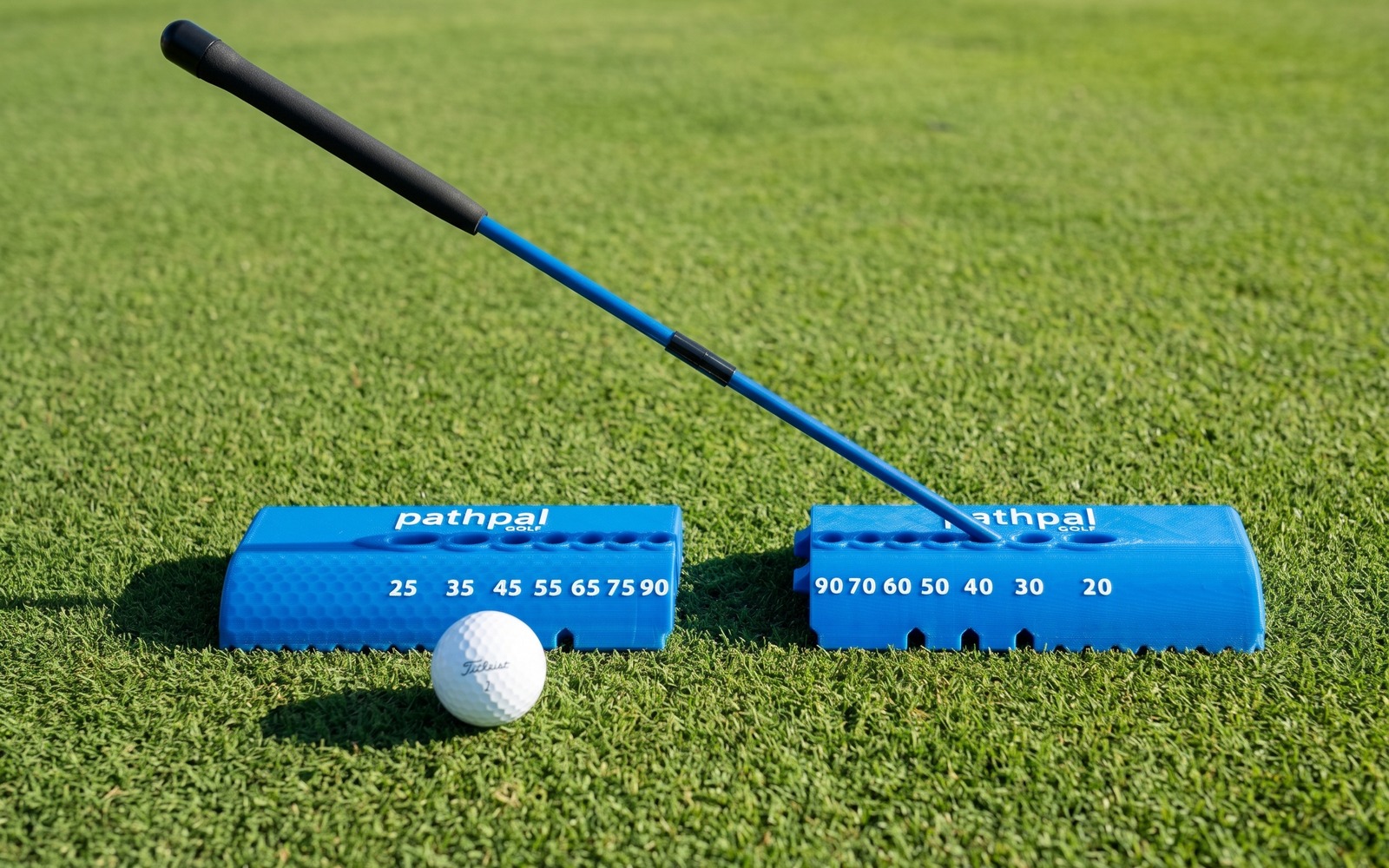
Scoring 94/100 in our full pathpal review—13 points higher than the B29 Blue Brick and 18 points higher than The Birdie Cube—the pathpal solves every structural headache we just documented on the two monolithic bricks. Molded in vibrant royal blue (#0B72CE) impact-resistant polymer in the USA, it measures 18″ × 4″ × 1.5″ when assembled and weighs roughly 2.5 lbs total. Instead of locking you into one heavy lump of metal, its center seam unlocks via a precision keyed interlocking dovetail joint into two independent 9″ × 4″ × 1.5″ stations (1.25 lbs per half). That means a single $110 unit (or $130 Pro Pair Bundle) gives you two separate bases for simultaneous front-and-back swing-path gates, hip-sway barriers, and split putting gates—the exact dual-station drills where Birdie Cube admits “Two Birdie Cubes Required” ($159.98–$199.98 and 8.10 lbs)!
Along its golf-ball-dimpled convex front slope, the pathpal molds 14 fixed, slip-proof ports spanning 20° to 90° in 5° steps (25, 35, 45, 55, 65, 75, 90 | 90, 70, 60, 50, 40, 30, 20) inside a raised scalloped collar, plus 6 trapezoidal 0° ground tunnels running perpendicular through the serrated bottom teeth for parallel foot-line and ball-position tracks. Because all 14 angles are molded directly into the solid housing, there are zero plastic rotary swivels to twist, loosen, or snap. Flip the station around on the practice green and the straight ~70° rear putting rail features 8 white vertical stroke-length hash marks (4 per half) so you can glide your putter shaft along a tour-true arc and set up a split putter/ball start-line gate.
Best of all, choosing the $130 Pro Pair Bundle pairs the 3/8″ pathpal with a pair of The Arrow padded collapsible sticks ($35 standalone pair / $60 2-pack, saving $15 vs. buying separately; or step up to the $185 Complete Training System with the truestrike low-point block). Each 3/8″ royal-blue fiberglass Arrow stick unfolds to a rigid 48 inches across just 3 × 16-inch braided shock-corded Z-fold sections (storing inside a ~17.5″ clear polycarbonate tube) and wraps its upper 16-inch third in a thick matte-black 360° protective foam sleeve—protecting $600 carbon driver crowns right out of the box with zero DIY pool noodles required. Our honest critiques from testing: the $110 solo base doesn’t include sticks (and requires picking 5/16″ or 3/8″ ports at checkout, which is why the $130 3/8″ Pro Pair Bundle is the smarter buy), its 2.5-lb polymer build is lighter than a 3-to-4-lb metal-bottom brick when holding a single stick at the shallowest 20°–25° angles on slick mats unless paired or anchored, and the buyer covers return shipping on 30-day returns.
📋 Key Hardware Specs & Score Breakdown
Fairways (Why It Beats Both Bricks)
- Splits in half via keyed dovetails into two independent 9″ stations—run dual-station swing tunnels and putting gates without buying two bricks
- 14 fixed, slip-proof molded ports (20°–90° in 5° steps) + 6 ground tunnels with zero plastic swivels to twist or snap
- $130 Pro Pair Bundle includes The Arrow (48″ → 3×16″ Z-fold w/ thick 16″ matte-black 360° foam sleeve) for $39 less than a single $169 B29 Blue Brick
- 3 built-in putting tools (~70° rear putting rail, 8 stroke-length hash marks & split gate) + 100% lefty/righty symmetry + 75+ drills from 25+ PGA coaches
Hazards (Watch Out For)
- $110 solo base does not include sticks and requires choosing 5/16″ or 3/8″ port sizing (the $130 Pro Pair Bundle eliminates the guesswork)
- At ~2.5 lbs total (1.25 lbs per half), it is lighter than a 3–4 lb metal-core brick at the shallowest 20°–25° angles on slick mats unless paired or tee-anchored
- 30-day money-back guarantee where the buyer covers return shipping
4. Tour Aim 3.0
If your primary complaint with both The Birdie Cube (4.05 lbs) and the B29 Blue Brick (3.0 lbs) is carrying a heavy metal-core slab in your stand bag—and your #1 priority on the practice tee is dialing in laser-precise parallel target lines alongside club-specific plane angles—the Tour Aim 3.0 (79/100) outscores The Birdie Cube by 3 points at the exact same $79.95 entry price.
Whereas the older Tour Aim 2.0 scored just 60/100 in our durability testing due to an open-backed shell that cracked under club strikes, the redesigned 3.0 adds a reinforced closed back, a raised impact rim, and a 1-year accidental impact warranty that explicitly covers ball and club strikes. Its flat black polymer plate holds two parallel ground sticks for “railroad track” target aiming while offering club-labeled swing-plane holes from Driver (48°) through Wedge (64°), a dedicated PATH hole for shallowing your angle of attack, and a tool-free adjustable putting gate with two sliding orange tabs.
Why does it rank behind the pathpal (94/100) and B29 Blue Brick (81/100)? Because it is a lightweight molded polymer plate rather than a heavy 2.5-to-3.0-lb station, it lacks the planted mass of the weighted bases on slick commercial range mats unless two ground rods are inserted to counterbalance the angled plane stick. In addition, while the base plate alone is a strong value at $79.95, stepping up to the bundles with sticks and alignment clips pushes the price to $124.95–$149.95.
📋 Key Hardware Specs & Score Breakdown
Fairways (Why Consider It Over Birdie Cube)
- Lightweight molded polymer plate is much easier to carry in a stand bag than the 4.05-lb Birdie Cube or ~3.0-lb B29 Blue Brick
- Reinforced closed-back 3.0 shell backed by a 1-year accidental club/ball impact warranty + 30-day money-back guarantee
- Includes a real tool-free adjustable putting gate with sliding orange tabs (which neither Birdie Cube nor Blue Brick offers)
Hazards (Watch Out For)
- Unweighted polymer plate requires ground rods inserted for stability on slick synthetic range mats
- Full bundles with sticks ($124.95–$149.95) cost as much as or more than the $130 pathpal Pro Pair Bundle
2026 Head-to-Head & Category Calibration
Between the two bricks, B29 Blue Brick (81/100) beats The Birdie Cube (76/100)—while the pathpal (94/100) beats both by splitting into two 9″ stations with 14 fixed angles, 360° padded Arrow sticks, and 3 putting tools.
Master Specification & Value Matrix: All Tested Swing Plane Stations Compared
How do The Birdie Cube and B29 Blue Brick compare against every alignment stick holder and swing plane trainer we have tested at Birdie Breakdown? Use our master laboratory table below—and if you want full breakdowns of the rest of the field, check out our 2026 Guide to the 8 Best Alignment Stick Holders & Swing Plane Stations and our 2026 Guide to the 8 Best Ball-Striking & Low-Point Training Aids.
Complete Category Comparison (Birdie Cube vs. Blue Brick vs. Category Benchmarks)
| Model | Verified Price | Birdie Score | Dimensions & Carry Weight | Splits in Half? | Angle Mechanism & Putting | Lefty Friendly? |
|---|---|---|---|---|---|---|
| the pathpal 🏆 | $110 solo / $130 Pro Pair w/ The Arrow | 94/100 | 18″×4″×1.5″ (two 9″ halves) · ~2.5 lbs | ✅ Yes (2 independent 9″ bases) | 14 fixed ports (20°–90°) + 6 ground tunnels + ~70° putting rail, 8 hash marks & split gate | ✅ 100% Symmetrical |
| Shotcraft B29 Blue Brick 🥇 | $169.00 (~$129 promo) | 81/100 | 8.5″×5.5″×1.5″ block · ~3.0 lbs | ❌ No (1-piece block) | 11 fixed drill setups (DR/6i/SW, Inside Swing, Wedge, Divots); edge track only | ⚠️ Partial (Wedge Impact is righty-only) |
| Tour Aim 3.0 🎯 | $79.95 – $149.95 | 79/100 | Lightweight closed-back molded polymer plate | ❌ No (1-piece plate) | Club-labeled holes (48°–64°) + PATH hole + sliding orange putting gate | ✅ Yes |
| The Birdie Cube 🥈 | $79.99 direct / $99.99 retail ($129 MSRP) | 76/100 | ~8.27″×7.5″×1.35″ (3.15″ w/ swivels) · 4.05 lbs | ❌ No (“Two Birdie Cubes Required”) | 5 fixed angles (20°, 50°, 60°, 65°, 90°) + 2 plastic rotary swivels (0°–90°); no putting rail | ✅ Yes (Centered Wedge 60° + swivels) |
| EyeLine Speed Trap 2.0 | $99.95 – $120.00 | 76/100 | Polycarbonate base plate (hardcover-book size) + soft foam rods | ❌ No | Repositionable soft foam rods forming a path gate around ball cutout | ✅ Yes |
| Stryper SwingMate | ~$115 – $134 | 76/100 | CNC aluminum rail · 3.7 lbs (1.7 kg) kit | ❌ No | Dual ratcheting hinges w/ 10° markers + 5 included rods | ✅ Yes |
| The Swing Plate | $115 – $140 | 74/100 | Steel baseplate · 1.76 lb (standard) / 3.3 lb (Dual) | ❌ No | Continuous 0°–90° friction hinge (requires wrench tightening) | ⚠️ Ground holder is righty-only |
| WhyGolf Alignment Discs | $69.99 – $89.99 | 70/100 | Two heavyweight ceramic discs · ~5 lbs each | ✅ 2 discs (10 lbs total!) | 6 notched settings (45°–90°); home/garage bay weight | ✅ Yes |
And what about the two worst-scoring swing plane bases in our test log? We still recommend skipping both the Swing Plane Perfector (68/100, an eye-watering $269.00 for a single CNC aluminum hinge block that works best spiked into real grass) and the PurePlane Pro Gen 3 (66/100, a $65.00 lightweight plastic disc that skids across synthetic driving range mats).
Who Should (and Shouldn’t) Buy Which Swing Block
Still deciding between The Birdie Cube, the Shotcraft B29 Blue Brick, or stepping up to a split-base station? Match your practice environment and swing goals to the profiles below.
Buy With Confidence If You…
- Want the #1 all-around swing plane, path & putting station for less than a B29 Blue Brick: Get the pathpal Pro Pair Bundle (94/100, $130 with a pair of 360° foam-padded Arrow sticks, or $110 solo). It splits into two 9-inch bases, locks 14 fixed angles (20°–90°), weighs just 2.5 lbs total, and includes 3 real putting tools.
- Are a right-handed range-mat regular who specifically wants Clay Ballard’s printed block system: Get the Shotcraft B29 Blue Brick (81/100, $169.00). Its solid one-piece molded ports, 3.0-lb mat stability, 27+ Top Speed Golf lessons, and clean 60-day money-back guarantee make it the clear winner between the two bricks.
- Are a left-handed golfer—or have a PGA TOUR Superstore / Nordstrom gift card—and strictly want a sub-$100 weighted block: Get The Birdie Cube (76/100, $79.99 direct / $99.99 retail). Its official kit list explicitly supports lefties with a dedicated left-handed wedge tutorial setting, and buying from a major retail store avoids the direct site’s contradictory return fine print.
- Want a lightweight molded polymer plate focused on parallel target lines and an impact warranty: Get the Tour Aim 3.0 (79/100, $79.95 base plate), which adds a 1-year accidental club-strike warranty and a sliding putting gate.
- Want to pair plane work with low-point or wrist-angle feedback: Combine your alignment station with a low-point mat like The Divot Board or wrist-extension telemetry from the HackMotion Wrist Sensor.
Think Twice (Expensive Range-Mat Traps to Avoid)
- Don’t swing under bare fiberglass rods with a $600 carbon driver without 360° foam protection: Both The Birdie Cube and B29 Blue Brick include bare fiberglass sticks—and Birdie Cube’s own tutorial page warns beginners to buy a DIY pool noodle. Either slide foam over those rods or buy a pair of The Arrow 360° padded collapsible sticks ($35 pair).
- Don’t buy two Birdie Cubes ($159.98–$199.98 & 8.10 lbs) just to run dual-station drills: A single $110–$130 pathpal splits into two independent 9-inch bases right out of the box.
- Don’t buy the B29 Blue Brick for a left-handed golfer: Its center
WEDGE IMPACT POSITIONslot is angled exclusively for right-handed shaft lean. - Don’t rely on Birdie Cube’s “Try for 30 days” headline without reading the return tab: On
birdiecube.com, the Shipping & Return accordion restricts returns to “most new, unopened items within 30 days.”
Frequently Asked Questions: Birdie Cube vs. B29 Blue Brick
Are The Birdie Cube and Shotcraft’s B29 Blue Brick made by the same company?
No. The B29 Blue Brick ($169.00, 81/100) is made by Shotcraft Golf in partnership with Top Speed Golf instructor Clay Ballard. The Birdie Cube ($79.99–$129.00, 76/100) is sold by Birdie Cube LLC (USPTO Word Mark Serial No. 99873404, filed June 9, 2026) and co-developed with Midwest PGA instructor Kevin Ward. However, our side-by-side teardown confirms that Birdie Cube replicated the B29 Blue Brick’s upper shallowing trio (DR / 7i / SW vs. DR / 6i / SW), upper-left INSIDE SWING slot, center WEDGE port, middle-right QR code, side ground ports, and heavy metal-sandwich base while swapping the lower two fixed slots for removable plastic rotary swivels.
Which is better overall: The Birdie Cube or the B29 Blue Brick?
In a strict two-block comparison, the Shotcraft B29 Blue Brick (81/100) beats The Birdie Cube (76/100) by 5 points. The Blue Brick is 1.05 lbs lighter in your golf bag (3.0 lbs vs. 4.05 lbs), uses solid one-piece molded slots instead of detachable plastic swivel turrets that can twist or crack, includes deeper biomechanical lessons from Clay Ballard, and backs your purchase with a clean 60-day money-back guarantee. However, the pathpal (94/100, $110–$130) outscores both single-piece blocks by splitting into two 9-inch stations, locking 14 fixed angles (20°–90°), and building in 3 putting tools.
Why does Birdie Cube tell users to put a pool noodle on its alignment sticks?
The Birdie Cube ships with two 6-segment black fiberglass rods that have small push-on foam balls on the tips only, leaving more than 95% of the fiberglass shaft completely bare. Because an accidental club strike during a swing-plane drill can snap the 5-ferrule rod or scratch a $600 carbon driver crown, Birdie Cube’s own tutorial page (birdiecube.com/pages/tutorials) explicitly warns beginners to slide a “foam tube (aka pool noodle) on the rods” during the learning phase. If you want factory club protection without hardware-store foam tubes, the $130 pathpal Pro Pair Bundle includes The Arrow sticks with a built-in 16-inch matte-black 360° protective foam sleeve.
Which swing block is better for left-handed golfers?
Between the two bricks, The Birdie Cube (76/100) is much better for left-handed golfers than the B29 Blue Brick (81/100). The B29 Blue Brick’s center WEDGE IMPACT POSITION slot is angled strictly for right-handed shaft lean and is incompatible with lefties. Birdie Cube explicitly lists “(Works for lefties too)” on its product page, includes a dedicated “Lefties: Left handed wedge setting” video on its tutorials page, and pairs a centered WEDGE ∠60° hole with symmetrical swivel sockets on both lower corners. For 100% lefty/righty symmetry across 14 fixed ports, 6 ground tunnels, and a 70° putting rail, our top pick for southpaws is the pathpal (94/100).
How much does The Birdie Cube actually cost in 2026?
The Birdie Cube has four different live price points depending on where you shop: a list MSRP of $129.00; a direct promotional price of $79.99 + Free Shipping on birdiecube.com (where the top banner says “Only $79” while the cart charges $79.99); a hidden 18Birdies partner page at $69.99; and a regular retail price of $99.99 at PGA TOUR Superstore, Nordstrom, and Walmart.
Can The Birdie Cube or B29 Blue Brick split in half for two-station drills or putting gates?
No. Both The Birdie Cube and the B29 Blue Brick are single-piece monolithic blocks that cannot separate. On Birdie Cube’s tutorial page, their two-station setup (“Double Birdie Cube Drill”) literally states “Two Birdie Cubes Required”—which would cost $159.98 to $199.98 and weigh 8.10 lbs. By contrast, a single pathpal ($110 solo / $130 Pro Pair) splits down the center via keyed interlocking dovetails into two independent 9-inch bases (1.25 lbs each).
Are The Birdie Cube and B29 Blue Brick legal to use during a USGA tournament round?
No. Under USGA Rule 4.3a (Use of Equipment), alignment stick bases and swing-plane blocks are practice training aids for the driving range, putting green, or simulator bay before or after your round. You may carry alignment sticks in your bag during a round, but placing any alignment block or stick on the ground to aid your stance or swing plane during a stipulated round incurs the general penalty (two strokes in stroke play or loss of hole in match play).
What is the deal with Birdie Cube’s 30-day return policy?
On birdiecube.com/products/the-birdie-cube, the product description invites you to “Try Birdie Cube… for 30 days” for a full refund, but the Shipping & Return accordion directly beneath it states: “You may return most new, unopened items within 30 days of delivery for a full refund.” Because you cannot test a golf swing trainer without opening the box, shoppers who want a Birdie Cube with hassle-free return protection are safer purchasing it from PGA TOUR Superstore or Nordstrom ($99.99). Shotcraft Golf backs the B29 Blue Brick with a clear 60-day money-back guarantee.
The Birdie Breakdown Final Verdict
| Contender | Verdict / Role | Verified Price | Birdie Score |
|---|---|---|---|
| Shotcraft B29 Blue Brick | 🥇 Head-to-Head Block Winner (Best 1-Piece Range Brick) | $169.00 | 81/100 |
| The Birdie Cube | 🥈 Budget Retail Clone Runner-Up (Best Brick for Lefties) | $79.99 – $99.99 ($129 MSRP) | 76/100 |
| the pathpal | 🏆 #1 Category Upgrade Winner (Splits Into Two 9″ Bases) | $110 solo / $130 Pro Pair | 94/100 |
| Tour Aim 3.0 | 🎯 Best Lightweight Multi-Rod Aiming Plate | $79.95 – $149.95 | 79/100 |
More Breakdowns & Guides You Might Like